
A browser football game is a game you play by loading a web page. No installer, no account, no store. That sounds like a distribution detail and is actually the defining design constraint of the whole category: the game has to be worth playing before you have invested anything at all in it.
This guide covers the whole picture — what exists, how it works, how to judge it, and how to get good at it.
Part 1: what exists
Browser football games divide into six families, which is the same taxonomy used throughout this site:
- Shooting — penalties, target practice, score attacks. The largest family by far, because a shot is the cheapest complete football story to build.
- Free kicks — shooting with an obstacle and usually a curve mechanic.
- Runners — lane-based dribbling with scrolling hazards.
- Skill games — juggling, passing chains, control challenges.
- Challenge formats — timed, survival, attempt-limited or averaged wrappers around any of the above.
- Management and tactics — decision games with no reflex component.
A Complete Guide to Football Arcade Games describes each family and what it tests. The practical use of the taxonomy is that it tells you what you are practising: shooting games train placement decisions, runners train reading ahead, skill games train timing precision, management games train inference.
Part 2: how they work
You do not need to know this to play, but it explains almost every quirk you will encounter.
Modern browser games draw into a <canvas> element — a rectangle of pixels the game repaints
sixty times a second — and run their logic in JavaScript. Four consequences you can feel:
- Everything is one thread. A heavy background tab can make a game stutter, because it competes for the same main thread. Closing tabs genuinely helps.
- Games are frame-rate dependent unless carefully written. Well-built games scale movement by elapsed time, so they play identically at 60Hz and 144Hz. Badly built ones run faster on faster displays.
- Pausing on tab switch is a fairness feature. Browsers throttle background tabs, so a timed game that kept running would give you a broken score. Ours pause.
- Sharpness depends on device pixel ratio. A game that ignores it looks soft on a high-DPI screen. It is a one-line fix that a surprising number of games skip.
How HTML5 Football Games Work goes into the detail.
Part 3: how to judge whether a game is good
Five signals, applicable in under a minute on any site:
| Signal | Good | Bad |
|---|---|---|
| Time to first play | One click from the page | Menus, logos, an account prompt |
| Objective clarity | Obvious without instructions | You are guessing what to do |
| Failure feedback | Tells you why you failed | Just ends |
| Difficulty | Ramps visibly and fairly | Unavoidable situations |
| Personal best | Remembered and shown | No record of your score |
The third row is the one people underrate. A game that tells you why a shot was saved is a game you can improve at; one that just shows a number is a slot machine.
Part 4: staying safe on games sites
A browser game should need almost nothing from you. If a site asks for more, that is information about the site.
- No downloads, ever. A browser game does not need an installer, a "player", or a codec. Any prompt to download something to play a web game should end the visit.
- No account for a two-minute game. Sign-ups exist to collect data, not to enable gameplay.
- No unexpected permissions. A football game has no legitimate use for your camera, microphone, location or notifications.
- Ads that stay outside the game. Advertising over or immediately beside a play area gets clicked by accident, which tells you what the page is optimised for.
- Working policy pages. A site with a real privacy policy and a real contact route is a site with someone accountable behind it.
Are Browser Football Games Safe? turns this into a longer checklist.
Part 5: where your scores live
Almost all browser games save your personal best in local storage — a small area of your browser, on your device, readable only by that site. Three things follow:
- Your score does not follow you to another device or another browser.
- Clearing site data deletes it permanently, and the site has no backup.
- A private or incognito window keeps nothing at all.
That is also why sites like this one can honestly say they do not know your scores. How Browser Games Save Your High Score explains it fully.
Part 6: getting better
Four habits carry across every browser football game:
- Read the scoring system first. Its highest and lowest value terms define the strategy before you play a single round. How to Build a High Score is the method.
- Place rather than blast. Power maps to height in almost every shooting game, so maximum power is usually the one setting that cannot score.
- Protect any multiplier. It compounds; individual bonuses do not.
- Read one step ahead in continuous games. Whatever is nearest is already too late.
And one meta-habit: make more attempts rather than longer ones. Every game in this genre ramps, so the instructive part of a run is at the end — three spaced attempts beat fifteen minutes of continuous play.
Part 7: desktop or mobile?
Both, for different games. Touch is the fastest input for aiming, because a tap is an absolute position. Keyboards win wherever you must hold a direction or make two inputs at once. Single-press timing games play identically on either.
Football Arcade Games for Desktop and Mobile Browsers has a game-by-game verdict, and Mobile Football Arcade Gameplay Tips covers grip, thumb position and settings.
Part 8: a first session, start to finish
If you are new to browser football games, this half-hour covers the genre:
- One-Touch Football, five minutes. Learn what a timing window feels like.
- Penalty Kick Challenge, ten minutes. Learn that power controls height.
- Football Dribble Run, ten minutes. Learn to read ahead.
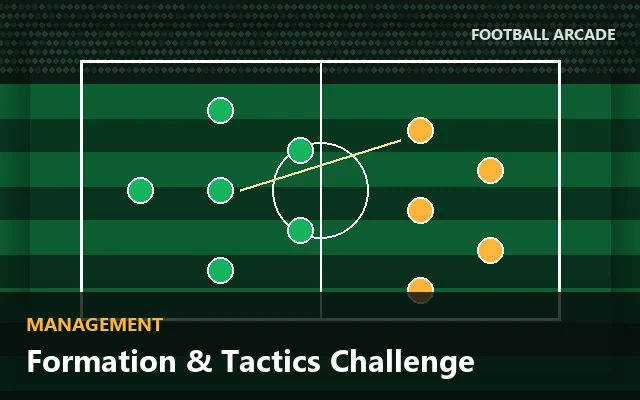
- Formation & Tactics Challenge, five minutes. See what the genre looks like without reflexes.
By the end you will know which family you enjoy, which is the only thing worth optimising for.
What browser football games are for
They are not a substitute for a simulation and not a substitute for football. What they are is the most frictionless form of deliberate practice available: a clear rule, immediate feedback, cheap failure, and a number that tells you whether the thing you changed worked.
That is a genuinely useful structure, and it is available in the time it takes a page to load.
Part 9: how browser games got here
Two shifts shaped the current landscape, and both explain things you will notice while playing.
The plugin era ended. For over a decade, browser games meant a plugin — a separate runtime the page embedded. When that support was withdrawn, an enormous catalogue of football games simply stopped working, which is why searching for old titles so often leads to dead pages. The games that survived were rebuilt on the web platform itself.
The web platform caught up. The <canvas> element, a frame-synchronised
animation callback and local storage between them cover almost everything a 2D arcade game needs. No plugin, no
installer, no permissions. That is why a modern browser football game is a normal web page — and why it can be
inspected, which is how you can verify the numbers any decent guide quotes.
Part 10: why the games are free
Worth understanding, because it explains the behaviour of the sites you will meet.
A short browser game has effectively zero marginal cost to serve — a few hundred kilobytes of static files — and no realistic way to charge for two minutes of play. So the funding model is advertising, and the quality of a games site is largely determined by how it resolves the resulting tension: advertising revenue scales with impressions, while the play experience degrades with every additional slot.
The visible symptoms of a site resolving that badly are consistent: advertising over or immediately beside the play area, interstitials between rounds, ads styled to look like game controls, and pages with more slots than content. A site resolving it well keeps advertising in the page layout and out of the game.
It is also why "no account required" is normal here and worth protecting. A free game with a mandatory sign-up is monetising something other than attention.
Part 11: what to expect next
Three directions are already visible, without needing to speculate:
- Better input handling. Pointer events unified mouse, pen and touch, which is why a well-built game now plays correctly on any device with one code path — the game-by-game verdicts in our desktop and mobile guide are about ergonomics rather than compatibility.
- Offline capability. Service workers make it possible for a games site to work with no connection. Few small sites do it, because caching a frequently-updated site risks serving stale pages — the trade-off is discussed in Do Browser Football Games Work Offline?.
- More honesty about mechanics. Players increasingly expect to know how a game is scored, which is a good thing: a published scoring rule is what makes a game improvable rather than a slot machine.
Part 12: a maintenance note for players
One practical thing worth knowing about any browser game site, including this one: your progress is not backed up anywhere. Personal bests live in your browser's local storage, which means they vanish if you clear site data, never existed in a private window, and do not follow you to another device.
If a score matters to you, write it down. That is not a limitation of this site so much as a property of how browser games store anything at all — How Browser Games Save Your High Score explains the mechanism and the trade-off against accounts and leaderboards.