Choosing badly is the most common way to waste a gaming break. You open something that needs fifteen minutes, give it four, and come away with nothing. The fix is to choose on constraints rather than on appeal.
Question 1: how long do you actually have?
Every game has one complete unit — a round, a run, a season — and if that unit does not fit your window, the game does not fit your window.
| Time | Play | Why |
|---|---|---|
| 1 minute | Football Reaction Test, Goal Target Challenge | Hard end, nothing left unfinished |
| 2–3 minutes | Football Score Attack, Penalty Kick Challenge | Fixed clock or fixed attempts |
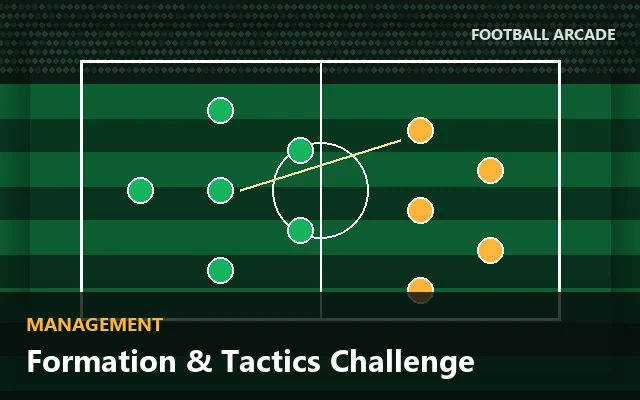
| 5 minutes | Formation & Tactics Challenge, Crossbar Challenge | A complete structured session |
| Open-ended | Football Dribble Run, Soccer Juggle | Endless — they end when you fail, not when time runs out |
The last row is the trap. Starting an endless game with two minutes left is how breaks become twenty minutes.
Question 2: what are you holding?
- A phone: tap-to-aim games are the fastest experience available. Goal Target Challenge and the tactics game are better on a phone than on a desktop.
- A keyboard: the runner, the keeper game and the juggling game all want held or repeated directional input.
- A trackpad: avoid free-aim games or play them with the arrow keys instead.
- Any of the above: every timing game plays identically, which is five of our eleven.
Football Arcade Game Controls Explained has the detail.
Question 3: do you want to aim, or to think?
These are genuinely different moods and they are badly served by each other.
Aiming and timing games give a fast loop, immediate feedback and a rising heart rate. Thinking games give a puzzle, no clock and the ability to look away. If you need to concentrate on something else in five minutes, a reflex game is the wrong choice regardless of how good it is.
The five signals of a game worth playing
Applicable on any site in under a minute:
- Time to first play. One click from the page. Menus, logos and account prompts are a signal about what the site is optimised for.
- Objective clarity. You should understand what you are trying to do before reading anything.
- Failure feedback. The game should tell you why you failed. A game that just ends is one you cannot improve at.
- Visible, fair difficulty. Escalation is good. Escalation you cannot perceive, or situations with no safe option, are not.
- A remembered personal best. The comparison is the point of the genre. A game that forgets your score has removed its own reason to exist.
Warning signs
- A download prompt. Browser games never need one. This should end the visit.
- An account for a two-minute game. Sign-ups collect data; they do not enable gameplay.
- Device permission requests. A football game has no use for your camera, microphone, location or notifications.
- Advertising over or beside the play area. It gets clicked by accident, which tells you what the page is for.
- No contact route or policy pages. Nobody accountable behind it.
Are Browser Football Games Safe? turns this into a fuller checklist.
If you still cannot decide
Default to Penalty Kick Challenge. It works on every device, takes two to three minutes, ends by itself, is easy on the first attempt and deep on the hundredth. There is no situation on this site where it is the wrong choice — only situations where something else is slightly better.
Choosing by what you want to get better at
The three questions handle the practical constraints. If you have a longer-term aim rather than a break to fill, choose by skill instead.
| You want to improve | Play | Measured by |
|---|---|---|
| Press timing | One-Touch Football | Longest chain |
| Placement under pressure | Penalty Kick Challenge | Goals from ten, and zero over the bar |
| Decision speed | Football Score Attack | Expired shot clocks per round |
| Reading ahead | Football Dribble Run | Distance |
| Consequence management | Soccer Juggle | Perfect contacts per run |
| Reasoning from information | Formation & Tactics Challenge | Points from six fixtures |
Note the measurements. Each is a specific count rather than a score, because scores are too noisy to tell you whether a change worked — see How to Practise Football Skills in Arcade Games.
One question that settles most choices
If the three questions and the table both leave you undecided, this usually settles it: do you want to finish, or do you want to keep going?
A fixed-clock or fixed-attempt game ends and gives you a number. An endless game does not end until you fail, which is more absorbing and much worse against a deadline. Knowing which of those you are in the mood for is generally more informative than any feature comparison.