Play
ManagementStrategy
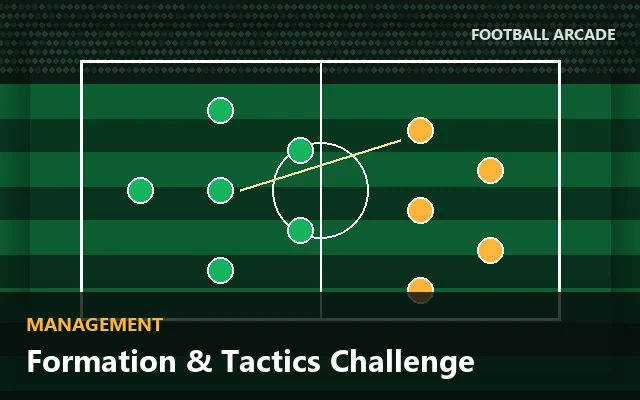
Formation & Tactics Challenge
Six fixtures, five formations, five approaches. No reflexes — just good reading.
Category
Formation choices, tactical matchups and decision games where thinking beats reflexes.
Not every football game needs fast hands. Management and strategy games ask a different question: given what the opponent does well, what do you do about it? There is no clock to beat and no shot to time — only a decision, a result, and an explanation of why it went that way.
1 game, all playable in the browser with keyboard or touch controls.
Six fixtures, five formations, five approaches. No reflexes — just good reading.
The long-form guides that anchor this category.
Management games ask a different question from every other football game: given what the opponent does well, what do you do about it? This guide explains how matchup models work, how to reason about formations and approaches, and how to stop guessing.
 How Formations Work in Management Games9 min read · updated 12 May 2026
 Counter-Attacking Tactics in Football Games9 min read · updated 31 May 2026
 How to Read an Opponent's Style9 min read · updated 18 June 2026
 Low Block vs High Press, Explained for Games9 min read · updated 7 July 2026
 Squad and Formation Decision-Making Tips9 min read · updated 25 July 2026
A game where your input is a decision rather than a movement. You choose a shape, an approach or a selection, the game resolves the match, and you learn from the result. The skill is reading information, not reacting to it.
No. Our Formation & Tactics Challenge explains the reasoning after every fixture, so the game teaches the matchups as you play. Knowing real football helps, but only a little.
There is a small random element in the scoreline, the same way there is in football. Over six fixtures the choices dominate: a good plan scores consistently, a bad plan occasionally gets away with it.
Yes — a full six-fixture season takes roughly five minutes, because you are making six pairs of decisions rather than playing ninety minutes.