Every other game on this site tests execution. Management games remove execution entirely: there is no timing window, no reticle and no reflex. You are handed information about an opponent and asked to make a decision, and then you find out whether the decision was good.
That makes them the only football games where thinking longer actually helps — and it makes them unusually good at teaching something real, because the whole game is inference.
What a management game actually models
Full management simulations model squads, finances, morale, training and a fixture list. A management arcade game strips that down to the part that produces decisions: the matchup.
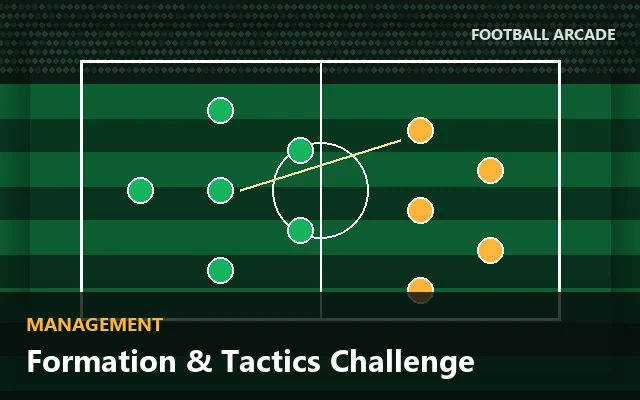
The model in Formation & Tactics Challenge is deliberately transparent and worth stating in full, because it is representative of how most matchup systems work:
| Quantity | How it is calculated |
|---|---|
| Attack rating | Starts at 2. Add 2 for each of your attacking traits the opponent is weak to. Subtract 2 for each trait they are strong against. |
| Defensive rating | Starts at 2. Add 2 for each opponent threat you cover. Subtract 1 for each threat you leave open. |
| Your goals | Attack rating divided by 1.6, plus a small variance, rounded. |
| Their goals | (6 − defensive rating) divided by 1.8, plus a small variance, rounded. |
Four things follow from those numbers, and between them they contain most of the strategy.
Consequence 1: defence is the more reliable half
Look at the coefficients. Covering a threat is worth +2 to your defensive rating; leaving one open is only −1. That asymmetry means the swing between covering both threats and covering neither is 6 points of rating — which translates to roughly three goals against you.
On the attacking side the swing is similar in magnitude but noisier, because it depends on how many of your traits happen to line up with the opponent's specific weaknesses.
Practical rule: cover the threats first, then see what attacking traits you get for free. A clean sheet is worth the same as a hat-trick and is easier to engineer.
Consequence 2: redundant cover is wasted
Your formation and your approach each contribute a set of covered threats. If both cover the same threat, the second one does nothing — the model checks whether a threat is covered, not how many times.
So against an opponent whose threats are pace and the flanks, picking a back five (which covers flanks, centre and pace) and a low block (which covers space, centre and pace) double-covers pace and leaves you having spent both choices on one problem.
Practical rule: read both of the opponent's threats, then pick two options that cover one each.
Consequence 3: some attacking traits are actively negative
Subtracting 2 for a trait the opponent is strong against means a bad attacking choice is worse than a neutral one. Against a deep block that is strong against transitions and direct play, choosing counter-attack contributes a trait they are specifically set up for — your attack rating drops from 2 to 0 and you will probably not score at all.
Practical rule: before you pick an approach, check whether it appears in the opponent's strengths. Avoiding a −2 is worth as much as finding a +2.
Consequence 4: variance is small but real
The variance term is a fraction of a goal, which means a good plan wins most of the time and occasionally does not. That is football, and it is deliberate — a model with no variance would make the game a puzzle with one correct answer per fixture.
Practical rule: judge your decision by the ratings the game reports, not by the scoreline. A 6-rating attack that produced one goal was a good decision that got unlucky.
How to read an opponent's style
The scouting note is the puzzle. Each opponent description contains the information you need if you translate it into the model's vocabulary:
| They are described as… | Which usually means | You want |
|---|---|---|
| Pressing high with a high line | Space behind their defence | Transitions, pace, direct play |
| Deep, compact, slow | No space behind; strong against transitions | Possession, width, crosses |
| Patient possession, narrow midfield | Vulnerable to pressure and to width | Pressing, wing play |
| Long balls and early crosses | Concedes control; threatens aerially and on flanks | Possession or pressing, with flank cover |
| Mid-block counter-attackers | Strong against your transitions; fast wingers | Possession and central overloads, with pace cover |
| Physical, packs the centre | Strong centrally; vulnerable in wide areas | Width and crosses, with aerial and central cover |
This is the same reasoning real analysts use, stripped to its skeleton. How to Read an Opponent's Style works through examples.
Formations as trade-offs, not pictures
A formation in a game like this is a bundle: it contributes some attacking traits and covers some threats. Learning the bundles is most of the game.
| Formation | Attacks with | Covers |
|---|---|---|
| 4-4-2 | Width | Flanks, aerial |
| 4-3-3 | Width, pressing | Pressing |
| 3-5-2 | Control, central overloads | Centre |
| 5-3-2 | Transitions | Flanks, centre, pace |
| 4-2-3-1 | Control, pressing | Centre |
Notice that 5-3-2 covers three threats and attacks with only one. That is the classic defensive trade-off made numerically explicit: it is the best answer to a dangerous opponent and the worst answer to a weak one, because you will struggle to score.
How Formations Work in Management Games goes shape by shape.
Approaches as the second half of the decision
| Approach | Attacks with | Covers |
|---|---|---|
| Direct | Direct play, aerial | Nothing |
| Possession | Control | Pressing |
| Counter-attack | Transitions, pace | Space |
| Wing play | Width, crosses | Nothing |
| Low block | Transitions | Space, centre, pace |
Direct and wing play cover nothing at all, which makes them high-risk choices: your formation has to do all the defensive work. Low block is the mirror image — three threats covered, one weak attacking trait. The middle three are the balanced options.
Low Block vs High Press, Explained for Games and Counter-Attacking Tactics in Football Games cover the two most conditional approaches.
A worked fixture
Say the opponent presses high, defends with a very high line, and pushes both full-backs forward. The scouting note says they will hurt you with pressing and with space in behind.
- Threats: pressing and space. Possession covers pressing. Counter-attack or low block covers space. 4-3-3 also covers pressing.
- Their weaknesses: transitions, pace, direct play. Counter-attack contributes both transitions and pace — two hits for one choice.
- Their strength: control. So possession is actively bad here: it would subtract 2.
- Decision: 4-3-3 plus counter-attack. 4-3-3 covers pressing; counter-attack covers space; counter-attack contributes two attacking traits they are weak to. Attack rating 2 + 4 = 6, defensive rating 2 + 4 = 6.
Expected result: around four goals for, around zero or one against. And note what made it work — not a favourite formation, but the fact that one choice solved two problems at once.
Where management games fit
They are the best football games for three specific situations: when you are on a phone one-handed, when you might be interrupted, and when you do not want to be wound up by a reflex game. There is no clock, so looking away costs nothing.
They are also the only games here where you can genuinely get better without any physical practice, which makes them oddly satisfying. Your fourth season will be better than your first purely because you understand the model — and understanding a model is a transferable skill in a way that stopping a power meter is not.
Squad and Formation Decision-Making Tips turns all of this into a checklist you can run in about ten seconds per fixture.
Worked season: six fixtures, twelve points
The model is easier to trust once you see it applied across a whole season rather than one fixture. This is a run through all six opponents in Formation & Tactics Challenge with the reasoning at each step.
| Opponent | Their threats | Pick | Why |
|---|---|---|---|
| High press, high line | Pressing, space | 4-3-3 + counter-attack | 4-3-3 covers pressing, counter covers space and hits two weaknesses at once |
| Deep block | Centre | 3-5-2 + wing play | 3-5-2 covers the centre; wing play hits width and crosses, both weaknesses |
| Patient possession, narrow | Centre, space | 4-2-3-1 + counter-attack | 4-2-3-1 covers the centre and presses; counter covers space |
| Long balls, early crosses | Aerial, flanks | 4-4-2 + possession | Only 4-4-2 covers aerial, and it covers flanks too; possession supplies control, a weakness |
| Mid-block, fast wingers | Pace, flanks | 5-3-2 + possession | Only 5-3-2 covers pace; possession carries the attack because 5-3-2's transitions are resisted |
| Physical, packs the centre | Aerial, centre | 4-4-2 + wing play | 4-4-2 covers aerial; wing play attacks width and crosses, their weaknesses |
Four of those six pick a formation because it is the only shape covering one of the threats. That is the most useful practical insight in the game: check for a compulsory formation first, then let the approach do whatever job is left.
Twelve points from six fixtures — three wins, three draws — is a good season with this reasoning. The draws tend to come in fixtures five and two, where the compulsory defensive shape leaves you short of attacking traits.
What a deeper model would add
Being clear about the limits, since the model is deliberately simple.
A fuller simulation would add players with attributes, so a formation's effectiveness would depend on whether you actually have wingers; form and fatigue, so choices would carry across fixtures; in-match phases, so you could change shape at half time; and interaction effects, so two of your own choices could combine into something neither produces alone.
All four would make the game better and longer. None of them would change the lesson the current model teaches, which is the one worth having: identify what the opponent does well, work out what beats it, and check that your plan does not accidentally play into their strength. That reasoning is the whole of tactical thinking, and it survives every layer of complexity you might add on top.