This is the practical companion to choosing a game: start from the time you have and work backwards.
Exactly one minute
Two games here are built for a minute, and both end on a hard stop:
- Football Reaction Test — eight rounds, about fifty seconds of actual play, and it finishes with a number you can compare to last time.
- Goal Target Challenge — a sixty-second clock that stops whether you are ready or not.
Both leave nothing hanging, which is the property you need when something else is about to demand your attention.
Two to three minutes
The genre's natural length, and where most of the site lives.
- Football Score Attack — ninety seconds, with a shot clock that sets the pace so it cannot overrun.
- Penalty Kick Challenge — ten kicks, two to three minutes, and you can tell by kick six whether it is a good run and stop guilt-free if not.
- One-Touch Football — unpredictable, but early runs are short and it ends decisively on three giveaways.
Five minutes
Enough for a game with structure rather than just a timer.
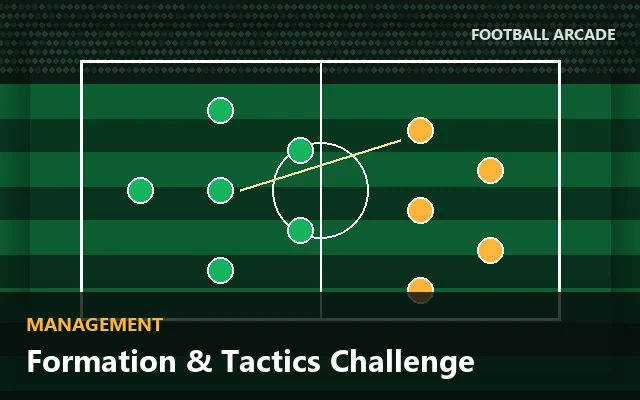
- Formation & Tactics Challenge — six fixtures of reading, choosing and reviewing. The best option if you need to think clearly about something else afterwards.
- Crossbar Challenge — ten attempts, and because the previous flight path stays on screen, the later attempts are genuinely better than the earlier ones.
- Free Kick Master — eight attempts across three stages each.
Fifteen minutes or more
Now the endless games make sense, plus a proper practice session.
- Football Dribble Run — you need several runs to reach the speed cap and learn anything from it.
- Soccer Juggle — rewards being warmed up, so a single cold attempt tells you nothing.
- A structured practice block. See How to Practise Football Skills in Arcade Games.
Match the structure, not the genre
| Structure | Ends when | Suits |
|---|---|---|
| Fixed clock | The timer hits zero | Hard deadlines |
| Fixed attempts | The last attempt is used | Predictable soft deadlines |
| Fixed fixtures | The season ends | Breaks where you want to think |
| Endless with lives | You fail | Open-ended time only |
Every game page on this site states a session length for exactly this reason, and endless games show a range rather than a number.
Why short sessions are better practice anyway
Not just a concession to your schedule. Every game here ramps, so the instructive part of a run is at the end. Long sessions give you more of the easy beginning plus fatigue — and in our testing, attempts two to four of a session are consistently the best while attempts six onward decline.
Three focused attempts with a pause between them will usually produce a better score, and certainly more learning, than fifteen minutes of continuous play. How to Beat Your Own High Score covers the session shape.
A note on stopping
Fixed-clock games help you stop because they end on their own. Endless games never do — the last thing that happened was always a mistake you want to correct. If you know that about yourself, choose the format accordingly, and not the game you most feel like playing.
The thirty-second game
Sometimes a minute is not available either. Two things are genuinely worth doing in thirty seconds, and it is worth knowing what they are rather than starting something you cannot finish.
Half a round of Goal Target Challenge. Not ideal, but the run has a hard end and an abandoned half-round costs nothing — the score simply stops where you left it.
Three or four kicks of Penalty Kick Challenge. Each kick is a complete unit with its own result, so stopping after four is a natural break rather than an abandonment. This is the best thirty-second option on the site.
What not to start: anything endless, and anything with a season structure. Both leave you mid-thing, which is worse than not having played.
Session length by device
Device changes the practical answer more than people expect, because it changes how likely an interruption is.
| Device and context | Realistic session | Best choice |
|---|---|---|
| Phone, standing, likely interrupted | One to two minutes, in fragments | Formation & Tactics Challenge or penalties |
| Phone, seated, uninterrupted | Five minutes | Goal Target Challenge, score attack |
| Laptop, at a desk | Fifteen minutes plus | Football Dribble Run, Soccer Juggle |
| Laptop, between meetings | Two minutes, hard stop | Anything with a clock |
The first row is the case most badly served by generic advice. Fragmented attention is not the same as a short session: it needs a game with no clock at all, which on this site means the tactics game or a kick-by-kick shooting game.
The fourth row is worth its own note, because it is the most common context of all. Two minutes with a hard stop is the one situation where a timed game is strictly better than a good game: you want something that ends by itself, so that the decision to stop is made for you rather than by you.