Long-range shooting feels harder because the goal looks smaller. That is the least important of the reasons. The real effects of distance are about time and error accumulation, and understanding them explains why a player who is excellent at penalties can be poor at a crossbar challenge.
Effect 1: angular margin shrinks
This is the one people intuit, and it is real. The goal subtends a smaller angle from further away, so the same angular error in your aim produces a larger positional error at the target.
Concretely: a one-degree error over 330 pixels of penalty flight misplaces the ball by about 6 pixels. The same one-degree error over 640 pixels misplaces it by about 11. Your aim did not get worse; the consequence of it doubled.
Effect 2: error accumulates over time, not distance
This is the effect that actually dominates, and it is why wind matters so much in long-range games.
A sideways acceleration — wind, curve, drift — displaces a ball in proportion to the square of the time it acts. So doubling the flight time quadruples the displacement from the same wind.
| Flight time | Sideways displacement |
|---|---|
| 0.4 s (a firm penalty) | ~3 px — irrelevant |
| 0.8 s | ~13 px — noticeable |
| 1.2 s (a long crossbar attempt) | ~29 px — larger than the target |
That is why our penalty game has no wind and the crossbar game does. At penalty range a crosswind would be invisible; at 64 metres it is the single biggest variable.
Effect 3: the keeper gets more time — but only in keeper games
In a game with a keeper, longer flight means more time to dive. Our penalty keeper needs 0.55 seconds to reach full extension, so at a 0.63 second flight it arrives fully extended and at 0.39 seconds only about 71% of the way.
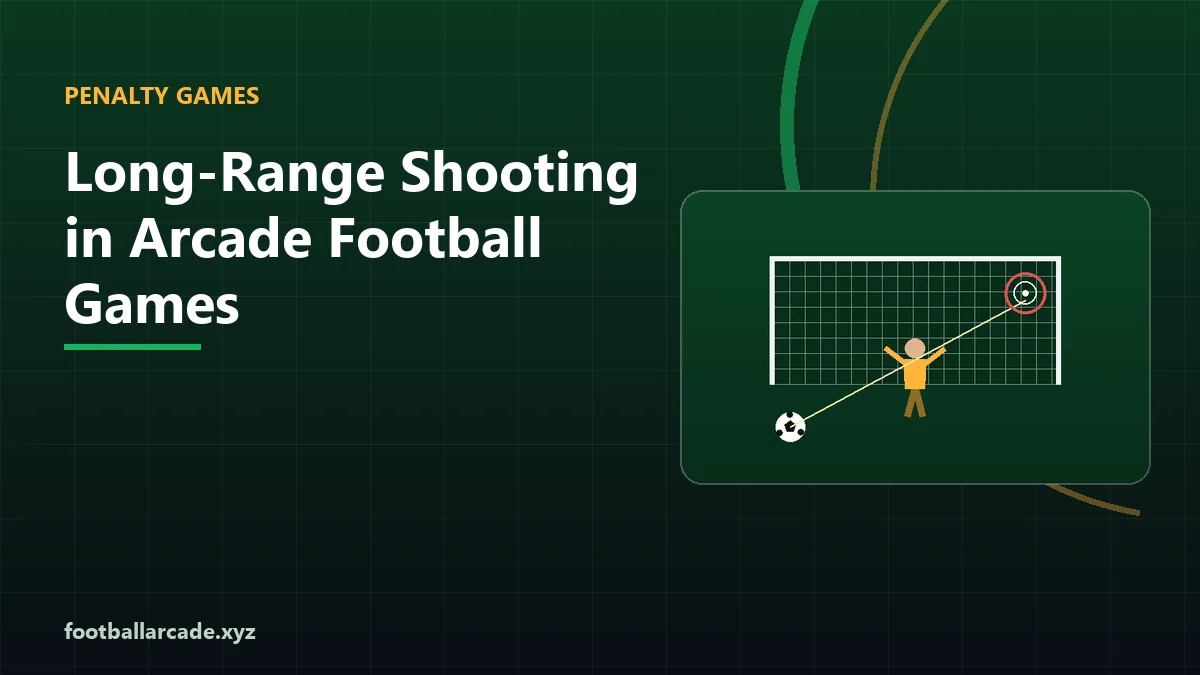
Extend that to a genuinely long-range shot and the keeper is always fully extended, which means power stops being a defence and placement becomes the only tool. That is a real strategic shift, and it is why long shots in football are aimed at corners rather than driven at a keeper.
Effect 4: your feedback gets better
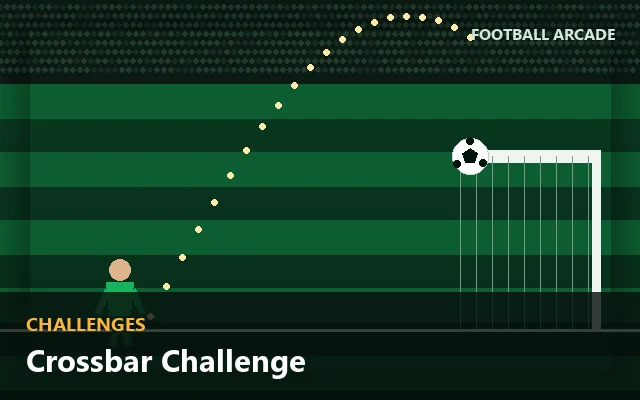
The one way distance helps. A long flight gives you time to watch the ball, and a visible arc you can compare against the last one. Our crossbar game keeps the previous path on screen for exactly this reason.
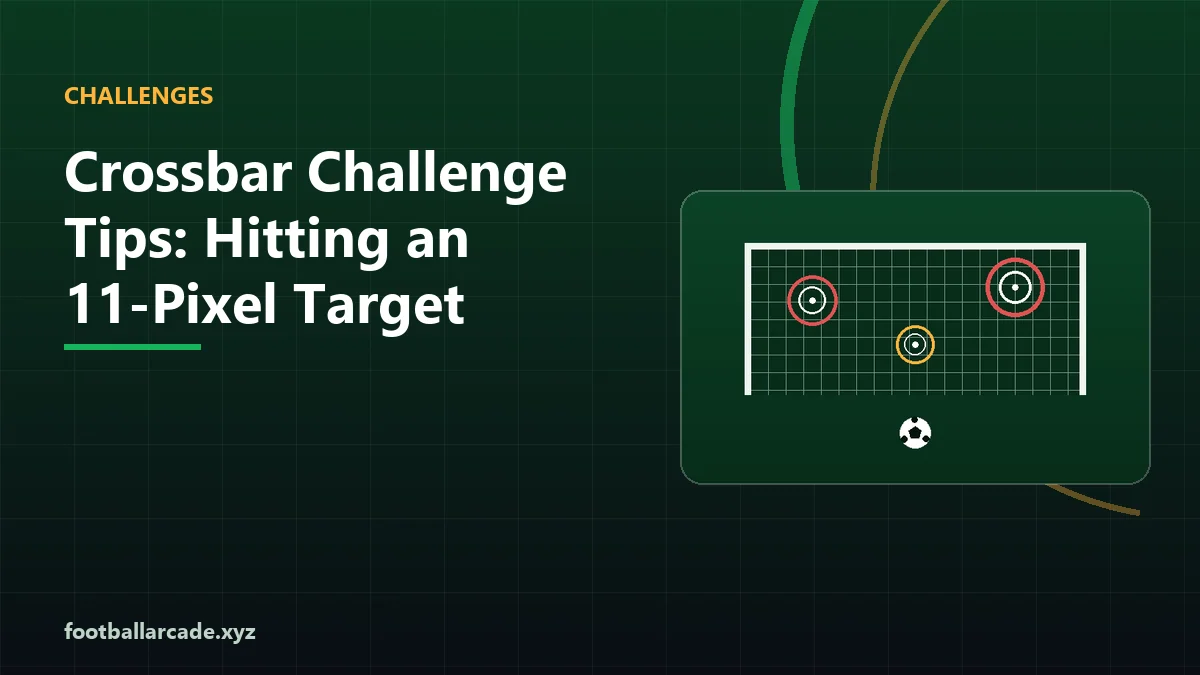
Short-range shooting is over before you can observe anything, so you learn from outcomes. Long-range shooting lets you learn from trajectories, which is much faster. Crossbar Challenge Tips builds a method around that.
The strategy changes that follow
- Compensate for the environment before you aim. At long range the wind is a bigger term than your aim precision, so reading it first is not fussiness — it is the main decision.
- Prefer descending arrivals. A ball crossing the target plane on the way down is moving slowly vertically, so it spends longer near any given height. On a small target that widens your margin more than better aim does.
- Stop relying on power. At long range power mostly controls where the ball lands, not whether a keeper can reach it.
- Iterate, do not aim. Change one variable per attempt and read the result. Long range is the one place in this genre where the correct approach is genuinely scientific.
Why penalty skill does not transfer
Worth stating plainly, because players are often surprised. Penalty shooting is a timing skill against a reacting opponent with a large target. Long-range shooting is a parameter-fitting skill against physics with a tiny target and no opponent at all.
They share almost nothing except the word "shooting". If you are excellent at Penalty Kick Challenge and hopeless at Crossbar Challenge, nothing is wrong — you are good at one skill and have not yet practised the other.
Football Skill Games Explained sets out how the various skills in this genre relate to each other.
How distance changes what you should practise
The four effects have a practical consequence: the drills that improve short-range shooting are close to useless at long range, and vice versa.
| Range | Dominant skill | Drill |
|---|---|---|
| Penalty distance | Timing precision and placement | Aim at one post repeatedly to measure your lead |
| Free-kick distance | Path planning around an obstacle | Zero-curve attempts to locate the wall, then curve calibration |
| Long range | Reading feedback and adjusting one variable | Fix the angle, change only power, compare flight paths |
Notice that the long-range drill contains no timing element at all. That is why players who are excellent at penalties often plateau immediately on the crossbar game: they are looking for a timing skill in a game that does not have one.
Why arcade games rarely go long
Worth asking why there are not more long-range football games, and the answer is instructive about the genre.
Long flights are slow. A one-second flight plus a result delay means each attempt takes two or three seconds of watching, which is dead time in a genre built on fast loops. That is why long-range games tend to be attempt-limited rather than timed — ten attempts with time to think fits the mechanic, while a sixty-second clock would mostly be spent watching the ball.
The trade-off is real and it is why Crossbar Challenge feels so different from the rest of the site: the pace is set by the physics rather than by a clock, and that changes it from a reaction game into a reasoning one.