A shooting game gives you a series of independent attempts. Miss one and the next is unaffected. A skill game gives you a chain, where the quality of each touch changes the conditions for the following one — and that single structural difference is what makes the category feel so different to play.
It is also what makes skill games the best category on this site for genuine, measurable improvement, because your failure point is a number you can watch move.
What a skill game actually measures
Three things, in different proportions depending on the game:
Timing precision
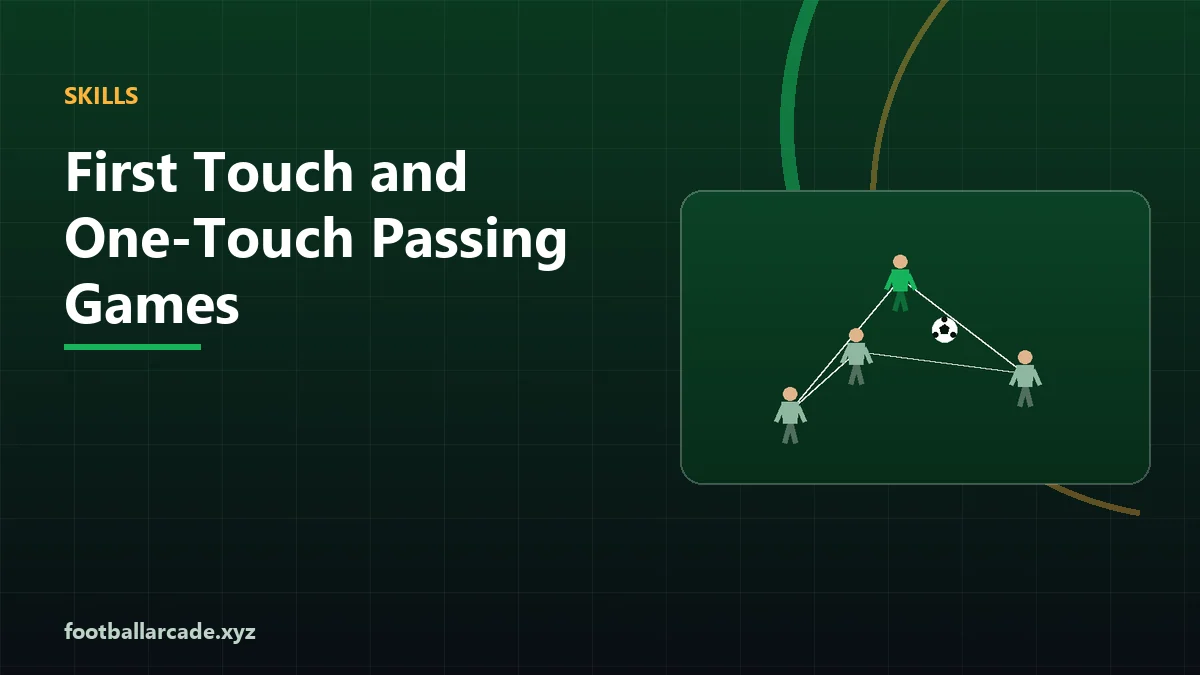
Not whether you can hit a window, but how accurately within it. One-Touch Football pays a bonus for contact inside 40% of the window rather than merely inside it, which turns a pass/fail input into a graded one.
Position management
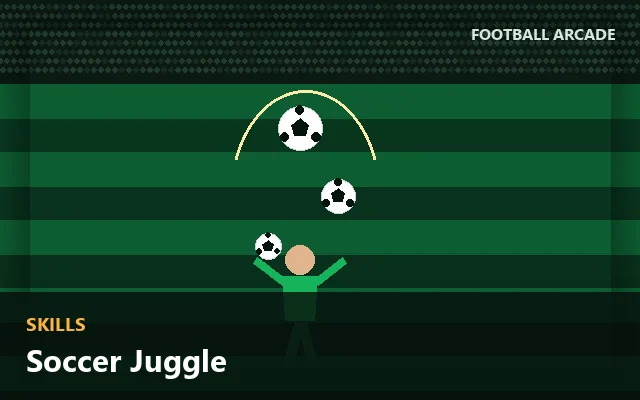
Being in the right place before the moment arrives. Soccer Juggle requires you to be within 46 pixels of the ball horizontally as well as inside the vertical contact band, which means moving and timing at once.
Consequence handling
Dealing with the state your last touch created. This is the part that is unique to the category: a mediocre touch is not just worth fewer points, it actively makes the next one harder.
How contact-quality scoring works
Most skill games grade your input rather than accepting or rejecting it, and understanding the shape of that grading tells you what to aim for.
In Soccer Juggle the game measures the distance between the ball and an ideal contact height, then converts it to a quality figure between 0 and 1. Points are 10 plus up to 20 more for quality, so a perfect touch is three times a scraped one. Crucially, quality also sets how high the ball goes — from about 400 units of upward velocity at the worst legal contact to about 590 at the best.
A good touch sends the ball higher, which gives you more time to position for the next one, which makes the next touch more likely to be good. A poor touch does the reverse. Runs do not end because of one mistake; they end because of a downward spiral that started three touches earlier.
The same principle appears in One-Touch Football from the other direction: every successful pass shortens the travel time and narrows the window, so success makes the game harder rather than easier. The reward for a long chain is a bigger per-pass bonus — up to 40 — which is the game paying you for accepting escalating difficulty.
Why off-centre contact is the most interesting mechanic here
In our juggling game, striking the ball off-centre pushes it sideways by three times the offset. Most players experience this as a punishment. It is actually the only tool you have.
The wind drifts the ball horizontally and changes every three and a half to six seconds. If your only move were a clean central contact, you would be permanently chasing the ball across the pitch until it drifted out of reach. Instead you can strike deliberately off-centre to push it back against the drift.
That turns a keep-up game into a control game: you are not trying to hit the ball perfectly, you are trying to place it where you want it for the next touch. It is the closest any game here gets to modelling what ball control actually means.
The order to learn them in
These games share a skill stack, and learning them out of order makes all of them harder than they need to be.
- One-Touch Football — timing only. One input, no movement, no aiming, and a visible ring that shows you the window. This is where you calibrate your sense of when a press lands.
- Football Reaction Test — timing plus a decision. Still one press, but now you must choose which. It separates your reaction from your decision speed, which are different and improve differently.
- Football Dribble Run — decision plus position, on a ramp. Continuous movement with discrete choices, but the timing is forgiving.
- Soccer Juggle — everything at once, with consequences. Position, graded timing, and a state you create yourself.
Skipping to the juggling game first is the most common mistake, and it is why some players conclude they are bad at skill games. They are not; they are attempting a four-variable problem without having solved the one-variable version.
How difficulty ramps — and why it always feels sudden
Skill games ramp on a schedule tied to your success, not to the clock. That makes the difficulty curve feel different from a timed game.
| Game | What tightens | When | Floor |
|---|---|---|---|
| Soccer Juggle | Gravity, by 42 units | Every 5 juggles | Caps at 1,180 |
| One-Touch Football | Contact window, by 0.009s | Every completed pass | Floors at 0.12s |
| One-Touch Football | Travel time, by 0.028s | Every completed pass | Floors at 0.34s |
Two consequences worth knowing. First, both games eventually stop getting harder, so a very long run is a plateau you can hold rather than an inevitable death. Second, the difficulty you are facing is a function of how well you have played — which means your personal best is always set at the hardest settings you have ever experienced. That is why beating it feels disproportionately difficult.
What to practise, specifically
Vague practice does nothing in this category. Pick one:
- If your juggling runs end below 20: practise contact height alone. Ignore the wind, stay central, and aim only to hit near the ideal line. You are building the habit of striking late, near the bottom of the band.
- If they end between 20 and 40: practise using off-centre contact on purpose to counter drift. Watch the wind readout rather than the ball.
- If they end above 40: you are fighting rising gravity. Stop chasing perfect touches and take consistent good ones — at high gravity the window is too narrow to gamble on.
- If your passing chains break early: count the rhythm out loud. Travel time is constant within a chain, so the tempo is predictable until your next successful pass changes it.
How to Practise Football Skills in Arcade Games turns this into a session structure.
The honest limits
Skill games train attention, timing precision and the discipline of managing a state you created. They do not train touch, because there is no ball and no foot. Anyone claiming a browser keep-up game improves your real first touch is guessing.
What is fair to say is that the mental habits overlap: playing the next touch rather than the current one is genuinely what good players do with a real ball, and it is exactly what these games force you to learn.
Why skill games feel unfair at first — and are not
New players often describe skill games as random. They are not, and the reason for the impression is worth understanding because it points straight at the fix.
In a shooting game, cause and effect are adjacent: you press, the ball goes somewhere, you see the result. In a skill game the cause of a failure is usually two or three touches earlier. A rushed contact high in the band gives less airtime, which leaves less time to position, which produces another rushed contact, which sends the ball sideways. The touch that "randomly" failed was the last link in a chain you started earlier.
Once you know that, the diagnosis changes. Instead of asking "why did I miss that one?", ask "where did this sequence start going wrong?" — and the answer is almost always a legal but low-quality contact that you did not register as a mistake at the time.
Measuring progress in a skill game
Scores in skill games are noisy because a run can end early for one bad sequence. Three better measures:
| Measure | In practice | Why it is better |
|---|---|---|
| Perfect-contact count | "Perfect" flags per run in Soccer Juggle | Directly measures the skill, independent of how long you survived |
| Wall contacts | How often the ball reaches a side wall | A direct read on whether you are steering or chasing |
| Chain length before first error | In One-Touch Football | Excludes the recovery phase, where the game deliberately eases off |
The transfer question, answered carefully
People reasonably want to know whether these games improve real football skill. The honest answer has two parts.
What cannot transfer: technique. There is no ball, no foot, no contact surface and no weight of strike. Nothing in a browser game will improve your first touch, your striking or your close control, and any site claiming otherwise is guessing.
What plausibly does: the habit of playing the next action rather than the current one. Skill games force it structurally — you cannot survive a juggling run by dealing with each touch as it arrives, because each touch determines the conditions of the next. That is the same mental discipline coaches describe as playing with your head up, and it is the only claim worth making.
We have not measured a transfer to real play and we are not going to pretend we have. Treat these games as what they are: an unusually clean way to practise timing, attention and consequence management, with immediate feedback and a score.