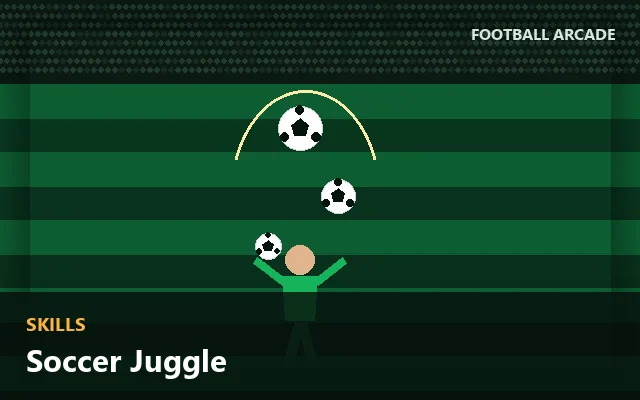

"Ball control" in an arcade game does not mean what it means on a pitch. There is no trapping the ball and no killing its momentum — in Soccer Juggle the ball is always moving, and the only thing you control is what you add to that movement.
Which makes control a prediction problem: you are not trying to stop the ball, you are trying to know where it will be and to put it somewhere useful.
The three forces you are managing
Gravity — predictable and rising
A constant downward acceleration starting at 780 units and rising by 42 every five juggles, capped at 1,180. Entirely predictable, which means it is never the reason you lose the ball. It is the reason your window gets smaller.
Wind — constant between changes
A horizontal acceleration between −44 and +44 that changes every three and a half to six seconds and is always shown in the HUD. Predictable within its interval, which is exactly long enough to plan around.
Your own contact — the only thing you add
Striking off-centre changes the ball's horizontal velocity by three times the offset, capped at 260. This is your entire control vocabulary.
Two of the three are given to you in advance. That is the key realisation: in a well-built skill game you are never surprised, only late.
Practice 1: learn the contact band, without the wind
Stay in the middle of the pitch and ignore drift entirely. Accept being slowly walked sideways. Your single goal is to strike as late as you dare — near the bottom of the shaded band, close to the dashed ideal line.
Why: contact quality sets both points and impulse. A contact on the ideal line gives roughly 590 units of upward velocity against about 400 at the edge of the band, which is 50% more airtime and therefore 50% more time to prepare the next touch.
Target: five consecutive touches flagged "perfect". Do not count juggles at all.
Practice 2: learn the offset, deliberately
Now the opposite. Stand deliberately to one side of the ball and strike, and watch where it goes. Do it in both directions until 20 pixels of offset has a felt meaning.
Why: this is your steering. If the wind is pushing right, standing slightly right of the ball pushes it back left. Players who never learn this are permanently chasing the ball into a wall.
Target: hold a rally within the middle third of the pitch for ten touches against a non-zero wind.
Practice 3: read rather than react
Play normally, but say the wind direction out loud each time it changes. It sounds silly and it works, because it forces your attention to the label rather than the ball.
Why: the wind is constant between changes, so it can be pre-empted. Moving to where the ball will be and waiting produces a late, high-quality contact. Chasing where it is produces an early, low-quality one — which is how spirals start.
The spiral, and how to break it
Runs rarely end because of one bad touch. They end like this:
- A rushed contact high in the band gives low impulse.
- Less airtime means less time to position for the next one.
- Which produces another rushed contact, this time off-centre.
- Which sends the ball sideways, requiring a bigger reposition.
- Which you cannot make in the reduced time.
The break point is step two. As soon as you get a poor contact, prioritise a clean next touch over a convenient one — even if that means letting the ball drift further. One good contact resets the whole sequence.
What control looks like in a passing game
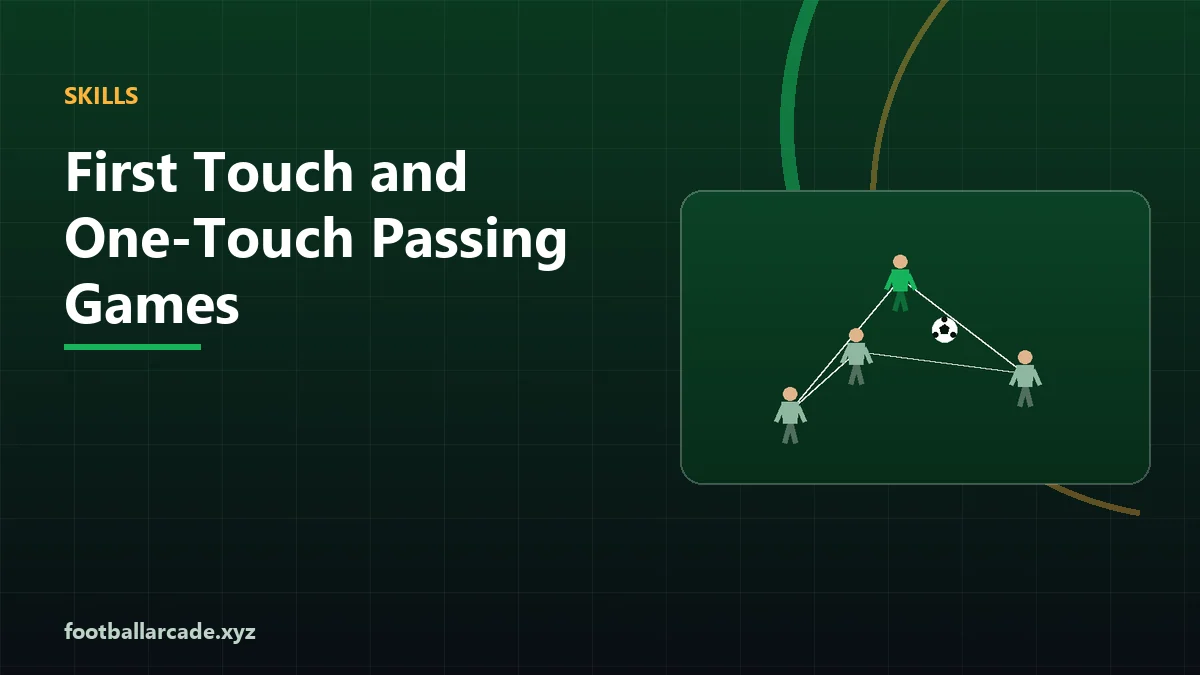
One-Touch Football has no position component at all, which makes it the control game for timing precision alone. The equivalent skill is rhythm: travel time is constant within a chain, so the tempo is predictable until your next successful pass shortens it.
Counting the rhythm out loud for the first few passes genuinely helps, for the same reason saying the wind out loud helps — it moves your attention from the object to the pattern. First Touch and One-Touch Passing Games goes further.
The honest limit
None of this improves your touch with a real ball. There is no foot, no contact surface and no weight of strike. What it does train is the habit of playing the next action rather than the current one — which is a real and transferable way of thinking, and the only thing these games can honestly claim.
Control as a budget rather than a skill
A reframing that helps: in a physics game you are not controlling the ball, you are managing a budget of momentum that you can only add to, never subtract.
Each strike adds upward velocity — 400 to 590 depending on contact quality — and adds horizontal velocity equal to three times your offset. Air drag removes a little horizontal speed over time, and the walls remove 22% of it per bounce, but nothing else reduces anything. So every touch either sets you up or spends part of your margin, and there is no neutral option.
That is why the habit of thinking one touch ahead is not just good practice — it is the only way to play. The question is never "can I reach this?" but "where will the ball be after I hit it?"
The three-touch plan
A concrete version of thinking ahead, and it fits in your head during a run:
- This touch: where is the ball relative to my player, and how clean can the contact be?
- Next touch: given the wind and the impulse I am about to add, where will it come down?
- The touch after: will I be able to stand there, or am I being walked toward a wall?
If the answer to the third question is "wall", strike off-centre now rather than in two touches' time. Steering early costs a little contact quality; steering late costs the run.
Football Juggling Tips covers the plateaus this fixes, and First Touch and One-Touch Passing Games the timing-only version of the same skill.