One-Touch Football is the simplest game on this site and the one most worth playing first. It has one input, nothing to aim, and no position to manage. What is left is timing — and because that is all that is left, it is the best place to learn it.
How the contact window works
The ball travels from one teammate to another over a fixed time. Your press has to land within a window centred on the moment of arrival:
| Chain length | Travel time | Window |
|---|---|---|
| 0 | 0.90 s | ±0.30 s |
| 5 | 0.76 s | ±0.26 s |
| 10 | 0.62 s | ±0.21 s |
| 20 | 0.34 s (floor) | ±0.12 s (floor) |
Two things to notice. The window is symmetrical, so swinging early is as much a giveaway as swinging late. And both values floor — beyond about twenty passes the difficulty is constant, so a long chain becomes a rhythm you can hold rather than an inevitable failure.
Watch the ring, not the ball
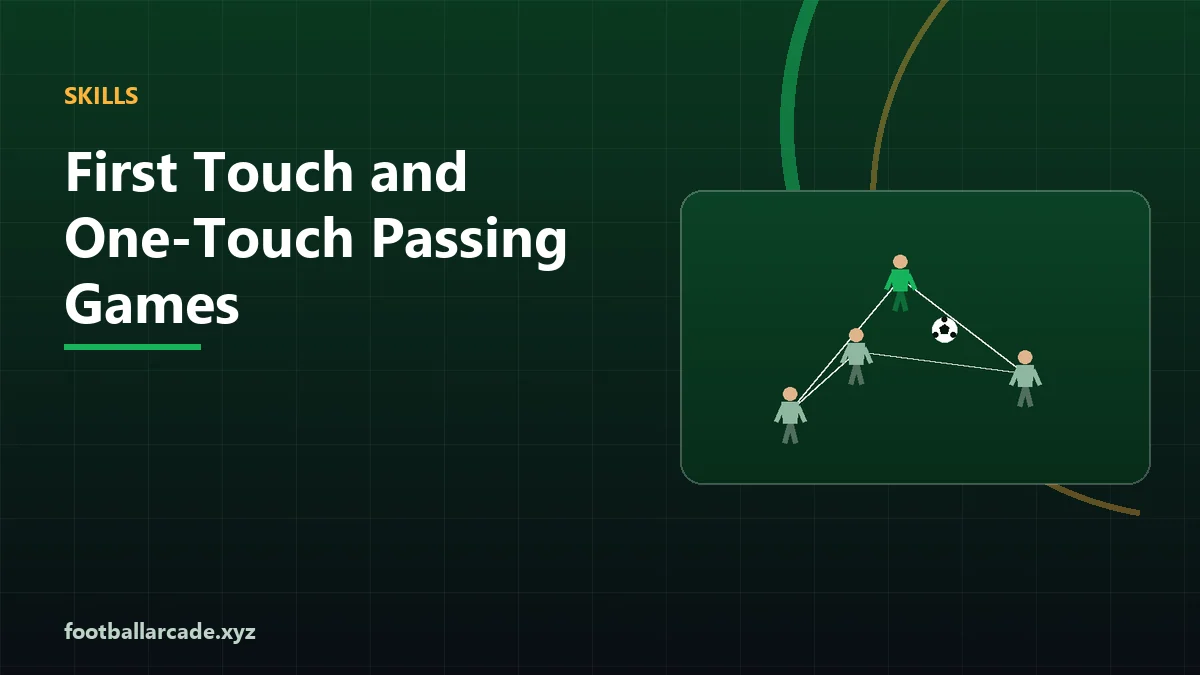
The single most useful habit. The receiving player has a ring that tightens as the ball approaches, and it turns green when you are inside the window.
That ring is a direct read on the timing. The ball's position is not — it is an object moving along a path, and judging its arrival requires you to estimate a rate. The ring does the estimation for you.
Players who watch the ring improve within a minute. Players who watch the ball plateau around eight to ten passes.
Count the rhythm
Travel time is constant within a chain and only changes when you complete a pass. That means the tempo is predictable, and the most effective thing you can do is treat it as music rather than as a series of events.
Counting out loud for the first few passes genuinely helps. It shifts you from reacting to each arrival to anticipating a beat, which is both faster and more reliable.
Why the game rewards accepting difficulty
Each completed pass is worth 10 points plus 2 per pass in the chain, capped at 40, with 10 more for a "perfect" touch inside 40% of the window. So a pass at chain 20 is worth five times one at chain zero.
That is the game paying you for accepting escalating difficulty, and it means the score is dominated by long chains rather than by total passes. Two chains of twenty beat six chains of six.
Recovering from a giveaway
After a giveaway the game eases off slightly: travel time increases by 0.1 seconds and the window widens by 0.03, within their limits. That is a deliberate recovery window.
Use it to re-find the rhythm rather than pushing. The pass after a mistake is the easiest pass you will get for a while, and treating it as a chance to re-establish the beat is how you avoid losing two giveaways in quick succession.
Why this is the best warm-up on the site
Two minutes here before any other game measurably sharpens the timing you need elsewhere — the second bar in Penalty Kick Challenge, the contact band in Soccer Juggle, the release point in Football Score Attack.
The reason is that all of those are the same underlying skill — pressing at an intended moment rather than a hopeful one — and this game isolates it completely. A Warm-Up Routine Before High-Score Runs puts it in sequence.
What "first touch" means here
In football, a first touch is what you do with the ball as it arrives — cushioning, redirecting, setting yourself. In a passing-rhythm game that is abstracted to a single binary: you played it on in one touch, or you did not.
That abstraction loses everything technical and keeps one real thing: the requirement to act at the moment of arrival rather than after it. Which is, genuinely, what makes one-touch play difficult on a pitch too — not the technique, the timing.
Where the chain actually breaks
Chains do not usually end because the window got too small. They end at a specific, identifiable moment, and knowing which one tells you what to work on.
| Symptom | Cause | Fix |
|---|---|---|
| "Too early" giveaways | You are reacting to the ball's approach rather than its arrival | Watch the ring, which tightens with the arrival rather than the approach |
| "Too late" giveaways | You lost the tempo after a speed change | Recount the rhythm on the pass after every successful one |
| Alternating early and late | You are guessing rather than tracking | Slow down deliberately: accept a shorter chain to re-establish the beat |
The third row is the one worth catching early. Alternating errors mean you have stopped tracking anything and are pressing hopefully, and no amount of trying harder fixes it — only deliberately restarting the rhythm does.
Why this game is worth playing badly on purpose
An unusual recommendation: play a round where you deliberately press as early as you can while still completing the pass, then a round pressing as late as you can. You will give the ball away repeatedly in both.
What you gain is the edges of the window. Most players know roughly where the middle is and have no idea how much margin they have either side, so they treat a comfortable window as a tight one and rush. Finding both edges once makes the centre obvious, and it is faster than gradually converging on it over a hundred careful attempts.
This is the same principle as the "late drill" in Football Juggling Games and Ball-Control Challenges: deliberately finding a limit beats cautiously approaching it.