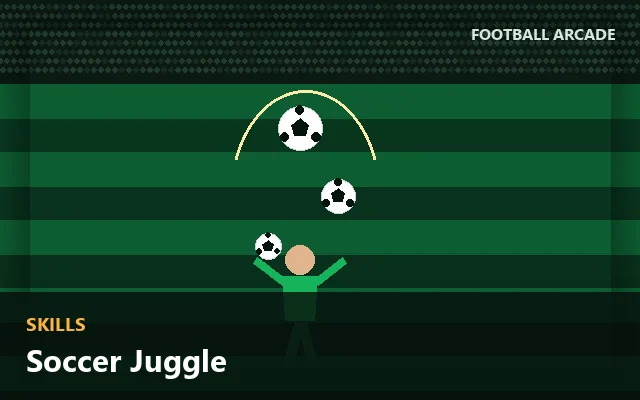

Juggling games have a reputation for being simple: press at the right moment, repeat. That description is accurate for about the first fifteen touches, after which the game you are actually playing is a small physics problem where every input changes the initial conditions of the next one.
All the numbers below are from Soccer Juggle, where they are published and verifiable.
The four systems in a keep-up game
- Gravity — a constant downward acceleration, starting at 780 units and rising by 42 every five juggles up to a ceiling of 1,180. This is the difficulty ramp.
- Wind — a horizontal acceleration between −44 and +44 that changes every three and a half to six seconds, always displayed in the HUD.
- The contact band — a vertical region in which a strike is legal, with an ideal line through it. Contact quality is the distance from that line.
- The reach — 46 pixels either side of your player. Outside it, a press does nothing except tell you it was out of range.
Every decision you make is a trade between these four. Understanding which one is beating you is how you get past a plateau.
Why contact height matters more than "good timing"
Most players think of a keep-up game as a timing test with a single correct moment. It is better understood as a height test, because the reward is graded by where the ball is, not when you pressed.
Quality is computed as the distance between the ball and the ideal line, normalised over 84 pixels. Points are 10 plus up to 20 for quality. But the more important consequence is the impulse: upward velocity runs from about 400 at the worst legal contact to about 590 at the best.
| Contact | Points | Upward velocity | Effect on the next touch |
|---|---|---|---|
| Scraped (edge of the band) | 10 | ~400 | Ball returns quickly and low — little time to reposition |
| Decent | ~20 | ~490 | Comfortable, repeatable |
| Perfect (on the ideal line) | 30 | ~590 | Maximum airtime, easiest possible next touch |
So a perfect touch is worth triple the points and buys you roughly 50% more airtime. In a chain, the airtime matters more than the points — which is the single most useful realisation in this game.
Strike late. Let the ball fall toward the bottom of the band rather than hitting it as soon as it becomes legal. Early contact in the upper part of the band is legal, low-quality and sets up a rushed next touch.
What the wind is really doing
The wind is not a nuisance mechanic; it is the reason the game needs your position as well as your timing.
Because it is an acceleration rather than a velocity, its effect compounds over the ball's flight. A 40-unit wind does not move the ball a fixed amount — it moves it increasingly far the longer the ball is airborne. Which produces a genuinely interesting tension: a perfect touch gives more airtime, and more airtime gives the wind more time to work.
Two habits handle it:
- Read the label, not the ball. The HUD shows direction and magnitude, and it is constant between changes. You can pre-position rather than chase.
- Move to where the ball will be, then wait. Chasing a drifting ball means arriving late and striking early in the band, which is the low-quality outcome that starts spirals.
Using off-centre contact deliberately
This is the mechanic that separates players who plateau in the twenties from players who get past fifty.
When you strike, the ball's horizontal velocity changes by three times the offset between the ball and your player, capped at 260 either way. Most players treat that as an error term. It is a steering control.
If the wind is pushing right, stand slightly to the right of the ball and strike: the offset pushes the ball back left, against the drift. You have converted a problem into a correction, and you can now hold the rally in one part of the pitch instead of being walked into the side wall.
The cost is quality — an off-centre strike still measures its height quality normally, so this is a horizontal correction rather than a free move. Use it when drift is the threat and clean contact when it is not.
The three plateaus and what each one means
Runs tend to end in three clusters, and each has a different cause.
Under 15: the reach problem
You are pressing when the ball is out of range, or outside the band. Both produce the same feeling — "nothing happened" — and the game tells you which it was. Fix: stay under the ball and ignore the wind entirely. Accept being walked across the pitch; you are learning the band.
15 to 35: the drift problem
Your contacts are legal but you are being pushed toward a wall, and the touches near the wall are rushed. Fix: start using off-centre contact to steer, and pre-position from the wind readout.
Above 35: the gravity problem
By 35 juggles gravity has risen by around 280 units from the start, so the ball falls through the band noticeably faster and the effective window is much shorter. Fix: stop attempting perfect contacts. At high gravity the margin for a perfect strike is thin, and a missed strike ends the run while a decent one continues it. Take consistent decent touches.
That last point is counterintuitive and it is the most common reason good runs end.
Side walls: a feature, not a boundary
The ball bounces off the left and right edges at 78% of its incoming horizontal speed, and off the ceiling at 55% of its vertical speed. This keeps the rally alive rather than ending it — but a wall bounce hands you a ball with unpredictable horizontal velocity, so it is a recovery mechanism rather than a tactic.
If you find yourself using the walls regularly, that is the drift problem above, and the answer is steering earlier.
A fifteen-minute improvement session
- Two minutes: band calibration. Stay central, ignore the wind, strike as late as you dare. Watch for the "perfect" flag. You are learning where the ideal line is in your hands, not your eyes.
- Four minutes: steering drills. Deliberately strike off-centre in both directions and watch the ball's path. Get a feel for how much 20 pixels of offset actually moves it.
- Four minutes: wind reading. Play normally but say the wind direction out loud each time it changes. It forces you to look at the label.
- Five minutes: real attempts. Three or four runs, with a short pause between them.
Most players add ten to fifteen juggles from one session, almost all of it from striking later and steering earlier.
Related games worth pairing it with
One-Touch Football is the natural warm-up: pure press timing with a visible window, which calibrates the same sense the juggling band needs. Football Dribble Run trains the other half — continuous positioning — without the timing precision. Playing all three in a session covers the whole skill stack, and Football Skill Games Explained sets out why that order works.
What a long run actually looks like
A sixty-touch run is not a single skill sustained for sixty touches — it is three distinct phases, and they need different behaviour. This is what the numbers do across a long attempt in Soccer Juggle.
| Touches | Gravity | The problem | What to do |
|---|---|---|---|
| 1–15 | 780–900 | Finding the band and the reach | Stay central, ignore the wind, strike late |
| 16–35 | 900–1,050 | Drift is walking you toward a wall | Steer with off-centre contact; read the wind label |
| 36–48 | 1,050–1,180 | The window is genuinely short | Stop attempting perfect contacts; take consistent decent ones |
| 49+ | 1,180 (capped) | Nothing gets harder | Concentration only — this is a plateau you can hold |
The fourth row is the one worth knowing in advance: gravity stops rising at 1,180, which it reaches at around 48 touches. If you get there, the game is not going to beat you with escalation any more. Runs that end at 55 or 70 end because attention lapsed, not because the game won.
Two drills that isolate the mechanics
Both deliberately produce bad scores, which is the point.
The wall drill. Play a run where your only objective is that the ball never touches a side wall. Ignore your juggle count entirely. You will steer earlier and more deliberately than usual, and the habit carries into normal play. Most players discover they were treating off-centre contact as an accident rather than as a control.
The late drill. Play a run where you try to strike as late as you possibly can — deliberately risking the ball dropping. You will lose the ball several times at first, and you will also collect more "perfect" flags than in any normal run, because the ideal contact line sits low in the band. Finding the actual edge of the band is faster than gradually approaching it.
Football Juggling Tips covers the three plateaus and their fixes, and How to Improve Ball Control the underlying skill.