A challenge game strips football down to a single measurable question. There is no opponent to beat, no league to win and nothing to unlock. There is a rule, a run, and a personal best sitting there daring you to have one more go.
What makes the category worth understanding is that "challenge" covers four genuinely different structures, and each one has a different optimal strategy. Playing a timed game the way you would play a survival game is the fastest route to a mediocre score.
The four formats
| Format | Run ends when | Dominant strategy | Our game |
|---|---|---|---|
| Fixed clock | The timer reaches zero | Maximise rate; never waste an attempt | Score Attack, Goal Target Challenge |
| Fixed attempts | You use your last attempt | Maximise value per attempt; patience is free | Crossbar Challenge, Penalty Kick Challenge |
| Survival | You run out of lives | Minimise risk; points are a by-product of living | Dribble Run, Soccer Juggle |
| Averaged rounds | A set number of rounds completes | Minimise variance, not maximise peaks | Football Reaction Test |
Notice how different those strategies are. In a fixed-clock game hesitation is a sin. In a fixed-attempt game hesitation is free and often correct. In a survival game the highest-scoring move is frequently to decline points. In an averaged game a single brilliant round is nearly worthless.
Football Score Attack — the fixed-clock benchmark
Ninety seconds, a patrolling keeper, a shot clock of 2.2 seconds that drops to 1.4 in the final thirty, and a multiplier climbing 0.15 per goal to a cap of 2.5.
The format's defining feature is that time passes whether you act or not, which makes the shot clock the most important mechanic in the game. An expired clock costs you the attempt and resets the multiplier — strictly worse than a saved shot, which at least tested the keeper.
The strategy: build the multiplier in the first thirty seconds while the keeper is still slow, then protect it. Shoot into the space the keeper has just left rather than the space in front of it. And in the last thirty seconds, with the clock at 1.4, take the first safe reticle position rather than the best one.
Goal Target Challenge — the fixed-clock variant with a selection problem
Sixty seconds, up to three shrinking rings, a 0.32 second reload, and a multiplier to 3.0.
Same format, different question. Because rings expire on their own, doing nothing costs you the multiplier too — so this is a fixed-clock game where the clock has teeth in two directions. The skill is choosing which ring to shoot, not hitting it.
The strategy: shoot the ring closest to expiring, always. It is simultaneously the highest value and the one whose loss would break your chain. Ignore the small ring across the goal; chasing it loses the multiplier twice on the way. Full detail in Football Target Shooting Tips.
Crossbar Challenge — the fixed-attempt benchmark
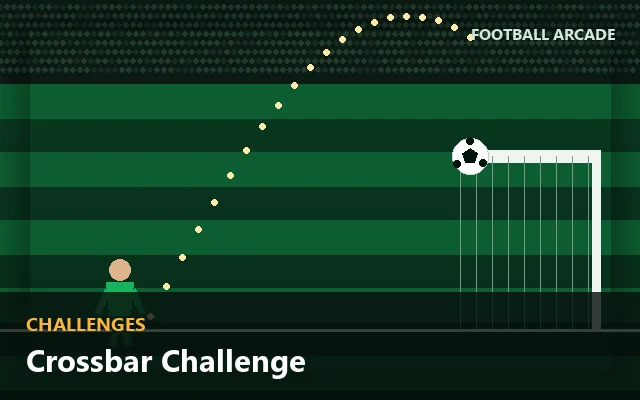
Ten attempts, a target 11 pixels tall, a crosswind of up to 60 either way, and 500 points for a hit against 80 for merely scoring.
Fixed-attempt games invert the timed-game instinct completely: there is no cost to thinking. You can stare at the wind readout and the dotted line of your previous flight for as long as you like, and the only thing that matters is what happens on the ten attempts you have.
The strategy: treat attempts one to three as calibration, not scoring. Fix one angle near 45 degrees and adjust only power and wind compensation. By attempt four you should be within 20 pixels of the bar, and the last six attempts are where your score comes from. Crossbar Challenge Tips walks through the arithmetic.
Football Dribble Run and Soccer Juggle — the survival benchmark
Both endless, both ramping, both ending when you run out of margin.
Survival formats have a property that catches people out: the optimal play is often to decline points. A loose ball in Football Dribble Run is worth 25, while distance pays a point every four metres — about nine points a second at full speed. So a ball that costs you two lane changes and any risk at all is a bad trade after the first minute.
The strategy: work out what a second of survival is worth, compare it to what the tempting option pays, and decline anything that loses that comparison. Then optimise purely for staying alive.
Football Reaction Test — the averaged benchmark
Eight rounds, a wrong direction costs 250 milliseconds, a false start costs 400 and the round is retaken, and your result is the average.
Averaging changes the game completely. In a best-of format you would gamble on every round, because only your fastest matters. In an averaged format a gamble that fails is permanently in your score — so the correct approach is to be slightly slower and never wrong.
The strategy: fingers resting on both arrow keys, eyes on the light rather than the ball, and absolutely no anticipation. A false start plus a retake is worth more than 400 milliseconds of damage spread across eight rounds.
The habit that improves scores in every format
One thing carries across all four: know what a mistake costs before you make one.
In each of these games the cost of an error is specific and knowable — a reset multiplier, a lost life, a wasted attempt, a 400-millisecond penalty. Players who have not worked that out play every situation with the same level of risk, which is guaranteed to be wrong in at least three of the four formats.
In Score Attack at a 2.5x multiplier, a goal is worth 125 plus placement. Losing the multiplier costs you the difference between 125 and 50 on every subsequent goal — potentially several hundred points across the rest of the run. That makes a "safe" central shot at high multiplier a bad idea and a moderately placed one a very good one, even though the immediate points differ by thirty.
How to pick a challenge game for your mood
- Want a fast loop and instant feedback? Fixed clock — Goal Target Challenge at sixty seconds is the shortest complete run on the site.
- Want to think rather than react? Fixed attempts — Crossbar Challenge rewards reasoning and punishes nothing else.
- Want something you can keep pushing? Survival — Football Dribble Run has no ceiling other than your concentration.
- Want a number about yourself? Averaged — Football Reaction Test in sixty seconds.
What makes a bad challenge game
Worth knowing so you can judge games elsewhere:
- An unclear scoring rule. If you cannot state how points are earned after one run, you cannot optimise and the game becomes a slot machine.
- Hidden difficulty ramps. Escalation is fine and necessary. Escalation you cannot perceive feels like cheating, because you cannot adapt to it.
- Runs that are too long. If a serious attempt takes fifteen minutes, you will not make enough attempts to improve, and every failure will feel disproportionate.
- No visible personal best. The entire point of the category is the comparison. A challenge game that does not remember your score has removed its own reason to exist.
If you want the general method for pushing a score in any of these, How to Build a High Score is the companion piece, and Football Challenge Game Strategies goes format by format in more detail.
Reading an unfamiliar challenge in one run
You can classify any challenge game — on this site or anywhere else — within a single run by answering four questions in order. The answers tell you the dominant strategy before you have played seriously.
- What ends the run? A clock, a number of attempts, running out of lives, or a fixed number of rounds. This alone picks your format and therefore your strategy.
- What does a mistake cost? A reset multiplier, a life, a wasted attempt or a time penalty. Price it before you take a risk.
- Is there a cooldown? A reload or a shot clock tells you the game is testing decisions rather than volume. Its absence usually means volume works, which is a design weakness.
- Does anything compound? A multiplier or accumulated progress means your risk appetite should fall as the run continues.
Four answers, one run, and you are playing the right game instead of discovering it over an hour.
Designing your own challenge
A genuinely useful trick when a game stops challenging you: change the win condition rather than the game. All of these are self-imposed and all of them are harder than the default.
| Game | Challenge |
|---|---|
| Penalty Kick Challenge | Ten goals from ten without repeating a corner |
| Football Dribble Run | Reach 600 metres without collecting a single loose ball |
| Goal Target Challenge | Hold 3.0x for the entire second half of the round |
| Crossbar Challenge | Two crossbars in ten, or zero goals — bar or nothing |
| Soccer Juggle | Thirty juggles without the ball touching a side wall |
| One-Touch Football | A chain of twenty with no giveaways at all |
The "no loose balls" run is the most instructive of these. Because distance pays about nine points a second at the speed cap and a ball pays 25, declining every ball costs you very little — and it removes the decision that ends most runs, which shows you exactly how much of your difficulty was self-inflicted.