
Challenge games all look similar: a rule, a run, a number. But the structure of how the run ends determines what a good decision is, and the four structures demand almost opposite behaviour.
Format 1: fixed clock — never waste an attempt
Examples: Football Score Attack at 90 seconds, Goal Target Challenge at 60.
Key property: time passes whether you act or not, so hesitation has a direct cost.
Dominant strategy: maximise the rate of decent attempts rather than the quality of individual ones. In Score Attack an expired 2.2 second shot clock costs the attempt and the multiplier — strictly worse than a saved shot, which at least tested the keeper.
The mistake: waiting for a perfect opportunity. In a timed format the perfect opportunity costs you the two decent ones you could have taken instead.
Format 2: fixed attempts — thinking is free
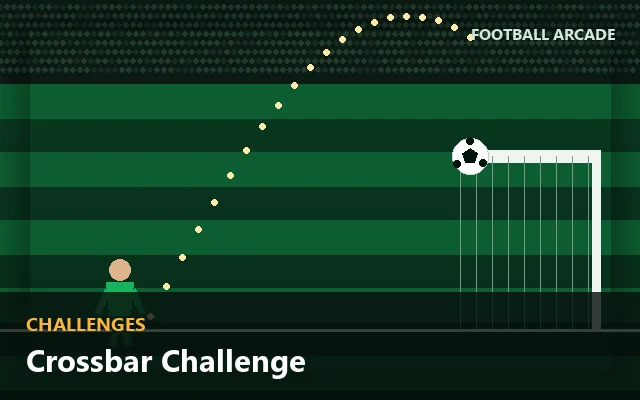
Examples: Crossbar Challenge at ten attempts, Penalty Kick Challenge at ten kicks.
Key property: nothing is consumed by deliberation. You can stare at the wind readout for a minute at no cost.
Dominant strategy: maximise value per attempt, and spend early attempts on information rather than on scoring. In Crossbar Challenge, attempts one to three are calibration — the previous flight path stays on screen, so each one makes the next more accurate.
The mistake: rushing. Players carry timed-game instincts into attempt-limited formats and waste the one advantage the format gives them.
Format 3: survival — decline points
Examples: Football Dribble Run, Soccer Juggle.
Key property: your score is a by-product of staying alive, and the run has no end other than failure.
Dominant strategy: price everything in seconds of survival. A loose ball in Dribble Run pays 25, while distance pays about nine points a second at the speed cap — so a ball is worth under three seconds. Any risk that might cost a life is a bad trade after the first minute.
The mistake: collecting. The tempting option is placed specifically to pull you out of a safe lane, and taking it is how most good runs end.
Format 4: averaged rounds — minimise variance
Example: Football Reaction Test over eight rounds.
Key property: every round is permanently in your result, so a failure cannot be discarded.
Dominant strategy: be slightly slower and never wrong. A false start costs 400 milliseconds spread across the average; a wrong direction costs 250. Neither is recoverable by being fast later.
The mistake: gambling. In a best-of format guessing would be rational. In an averaged format it is simply expensive.
Summary table
| Format | Hesitation | Risk appetite | First priority |
|---|---|---|---|
| Fixed clock | Expensive | Moderate, constant | Rate of decent attempts |
| Fixed attempts | Free | High early, low late | Information, then value |
| Survival | Free | Falling as the run continues | Staying alive |
| Averaged | Cheap | Very low | Avoiding errors |
The cross-format rule
One principle applies everywhere: know the price of a mistake before you make one.
In each format the cost of an error is specific and knowable — a reset multiplier, a wasted attempt, a lost life, a 400-millisecond penalty. Players who have not worked it out apply the same risk appetite to every situation, which is guaranteed to be wrong in at least three of the four.
How to Build a High Score is the general method, and The Best Football Challenge Games covers which games use which format.
Recognising the format before you play
You can classify a challenge game before touching it, from the HUD alone. Whatever the game chose to put on screen is what it has decided matters.
| The HUD shows | Format | First priority |
|---|---|---|
| A countdown clock | Fixed clock | Rate — never waste an attempt |
| "Attempt 3 / 10" | Fixed attempts | Information, then value per attempt |
| Lives, or a life indicator | Survival | Staying alive; points are a by-product |
| "Round 3 / 8" plus an average | Averaged rounds | Avoiding errors |
| A multiplier | Any of the above, plus a chain to protect | The chain outranks everything else |
Our game pages list the same information in the "At a glance" panel and the scoring table, so you can decide your approach before the first run rather than after five.
The mistake that is specific to each format
Each format has one characteristic error, and naming it is usually enough to stop making it.
- Fixed clock: waiting for a good opportunity. The good opportunity costs you the two adequate ones you could have taken instead.
- Fixed attempts: rushing. Nothing is consumed by thinking, so hurrying gives away the one advantage the format offers.
- Survival: collecting. The tempting item is placed specifically to pull you out of a safe position.
- Averaged rounds: gambling. A wrong guess is permanently in the average and cannot be outrun by being fast later.
Three of those four are errors of the same kind — applying the wrong relationship with time — which is why identifying the format first is worth more than any game-specific tip.