
When players say they are inaccurate, they usually mean their shots go to unpredictable places. Almost always that is wrong. Miss patterns in arcade games are remarkably consistent: people miss the same way over and over, and once you can name the pattern you can correct it in a single session.
The reason is that almost no aiming system in a browser game is a test of hand-eye precision. They are tests of prediction — you are pressing a button to stop something, or to release something, and the gap between when you decide and when the game registers it is where your error lives.
The three aiming systems and what each one actually measures
Timed reticle: you are measuring your own lag
A marker sweeps and you stop it. The marker does not stop where you saw it — it stops where it was when your press arrived, which is later. That delay is the sum of your reaction and your hardware, typically over a tenth of a second, and at the speeds these games use that is a real distance.
In Penalty Kick Challenge the reticle crosses the goal in under a second on late kicks. A 150-millisecond delay is therefore tens of pixels of error — always in the same direction as the sweep.
Free aim: you are measuring your pointer control
You move a crosshair and shoot. Here the error is spatial rather than temporal, and it is usually undershoot: people stop the pointer short of a target and fire, because stopping precisely takes longer than firing does. Goal Target Challenge works this way.
Parameter setting: you are measuring your arithmetic
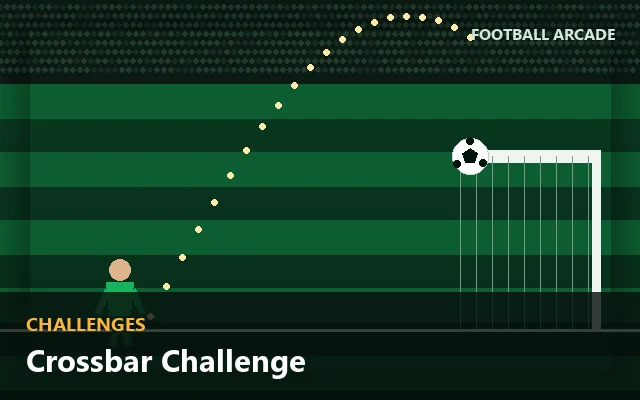
You set an angle and a power and the physics does the rest, as in Crossbar Challenge. There is no hand-eye component at all — accuracy here is entirely about reading feedback from the last attempt and adjusting one variable.
Three completely different skills, often confused with one another. The first thing to do is work out which one you are actually failing at.
The ten-minute diagnosis
This is the single most useful exercise in this guide. You are not trying to score; you are collecting data about yourself.
- Open Goal Target Challenge and play one round deliberately badly slowly. Take about half as many shots as usual and, for each miss, note whether the ball landed short of the target, past it, above it or below it. Do not correct anything yet — just record.
- Play one round of Penalty Kick Challenge aiming only at the left post. Note where the ball actually finishes. Most players find it lands consistently to one side of where they intended, and that side matches the direction the reticle was travelling.
- Play four attempts of Crossbar Challenge at the same angle. If your shots scatter wildly, you are not reading the wind. If they cluster but in the wrong place, you are reading it and mis-compensating — a much easier fix.
By the end you will have one of four diagnoses, and each has a different correction.
Diagnosis 1: you press late on sweeping reticles
This is the most common single problem in football arcade games, and it explains why so many players' shots drift consistently toward one side of the goal.
The fix is not to react faster. It is to press early on purpose. Decide where you want the ball, then press when the reticle is a visible distance before that point — roughly the width of the reticle's own marker to start with, adjusted from what you observe.
Play a penalty round where your only goal is to land the ball exactly on the left post — not inside it, on it. You will miss wide repeatedly at first. The distance you consistently overshoot by is your lead time, and once you know it you can apply it everywhere.
Because sweep speed rises with each kick in our game, the lead you need grows through the round. Expect to lead slightly more on kick nine than on kick two.
Diagnosis 2: you undershoot with free aim
With a mouse or a trackpad, most people stop the pointer just short of a target and fire immediately. The result is a cluster of near-misses on the side you were approaching from.
Two corrections, in order of effect:
- Overshoot deliberately and settle back. Move past the target and pull back onto it. It feels slower and is usually faster, because the final movement is small and controlled.
- Park the pointer centrally between shots. Every target spawns inside the goal frame, so the centre of the goal is the shortest average distance to the next one. This alone measurably improves target games with a clock.
If you are on a trackpad, read Playing Football Games on a Laptop Trackpad before concluding you are bad at aiming — trackpad acceleration curves genuinely make free-aim games harder.
Diagnosis 3: you are not reading feedback
In parameter games the information you need is on screen and most players ignore it. Our crossbar game leaves the previous flight path visible as a dotted line specifically so you can compare attempts, and it tells you in pixels how far over or under the bar you were.
The discipline is to change one variable per attempt:
- Shot cleared the bar by a little? Same angle, slightly less power.
- Shot dropped short of the line? Same angle, more power.
- Shot landed wide of where you expected on both attempts? You are not compensating for the wind — read the label, not the ball.
Changing two variables at once is why players feel like these games are random. They are not; the feedback is just being wasted.
Diagnosis 4: your accuracy is fine and your selection is bad
This is worth naming because it masquerades as inaccuracy. In a game with a clock and a multiplier, hitting a hard target and missing an easy one nets you less than hitting two easy ones — so a player with good aim and bad choices scores like a player with bad aim.
The tell is simple: if your misses are mostly at small or distant targets, your problem is target selection, not accuracy. Football Target Shooting Tips is the fix.
Why placement beats precision almost everywhere
There is a structural reason to stop chasing pixel-perfect accuracy, and it is in how these games score.
Placement bonuses in every game on this site scale with distance from the centre of the goal and then saturate. In Penalty Kick Challenge the bonus reaches up to 45 points as the ball approaches a post — which means being 90% of the way there collects about 40 points. The final 10% of precision earns five points and adds a genuine chance of missing the frame entirely, which costs 100.
Expected value says aim a few pixels inside the post. Precision beyond that is a hobby, not a strategy.
A practice routine that actually transfers
Twelve minutes, three games, one variable each:
- Three minutes on One-Touch Football. Pure press timing with a visible window. This is calibration, not scoring.
- Four minutes on Goal Target Challenge, deliberately overshooting and settling back on every target.
- Five minutes on Penalty Kick Challenge, applying the lead time you measured and capping power at 90%.
Do this once and your penalty conversion will usually improve by two or three goals a round. Do it three times in a week and the lead-time correction becomes automatic, which is the point — the goal of practice is to stop having to think about it.
What none of this will do
It will not make you accurate with a real football. Your feet are not involved, there is no contact point, and no browser game models the weight of a strike. What transfers is the mental half: committing to a target, reading feedback, and resisting the urge to chase the spectacular option. Those are real and useful. The technique is not on offer here, and any site telling you otherwise is selling something.
Accuracy under fatigue
One factor worth isolating because it is invisible while it is happening: accuracy degrades measurably across a session, and it degrades in a specific direction.
What gets worse first is not your aim but your lead. As you tire, your reaction lengthens slightly, which means a timed reticle travels a little further during it — so your shots start drifting in the direction of the sweep. The error looks like carelessness and is actually arithmetic.
Two practical consequences. First, if your shots start drifting one way late in a session, increase your lead rather than concentrating harder. Second, a record attempt belongs in attempts two to four of a session, not attempt ten: by then you are fighting a moving target.
A two-week accuracy log
If you want to actually fix a bias rather than notice it, write down two numbers per session. Nothing else is needed.
| Record | From | Reading it |
|---|---|---|
| Shots over the bar | One penalty round | Anything above zero is power discipline, not accuracy |
| Shots wide | The same round | Anything above zero means you are aiming at the post, not inside it |
| Peak multiplier | One target round | A direct measure of consistency, unaffected by target values |
| Crossbar attempts within 20px | One crossbar game | Measures your feedback loop rather than your aim |
Two weeks of this beats months of undirected play, for one reason: every entry names a specific correction. A score does not.