A scoring system is not a reward mechanism bolted onto a game — it is the game's statement of intent. Read it properly and you know the optimal strategy before you play. Ignore it and you will spend hours discovering the same thing by trial and error.
The four components
| Component | Example | Rewards | Implication |
|---|---|---|---|
| Base value | 100 for a penalty goal | Completing the action | Never risk it for a bonus |
| Scaled bonus | Up to 45 for placement | Execution quality | Find where it saturates and stop there |
| Multiplier | Up to 3.0x for consecutive hits | Consistency | Protect the chain above all else |
| Penalty | A reset chain, a lost life, +250ms | Risk management | Price the mistake before making it |
Base values set the floor of your ambition
When the base value dominates, the game is telling you that completing the action is nearly everything. Our penalty game pays 100 for a goal against a maximum of 60 in combined bonuses — so a goal with no bonuses beats a miss with perfect placement, every time.
The corollary is a rule you can apply blindly: never take a risk that jeopardises the base value in order to collect a bonus.
Scaled bonuses always saturate
This is the most exploitable property in arcade scoring. Scaled bonuses are typically linear in a normalised distance, which means the final stretch of risk buys very little reward.
| Distance toward the post | Bonus | Added risk |
|---|---|---|
| 50% | ~22 | None |
| 80% | ~36 | Negligible |
| 90% | ~40 | Small |
| 100% | 45 | Real — a miss costs 100 |
Five points for a genuine chance of scoring nothing. Find the saturation point in any game and treat it as the target.
Multipliers compound, and that changes everything
A multiplier is the only component that affects points you have not yet earned. That makes it structurally different from a bonus, and it is why in a game with both, the multiplier dominates.
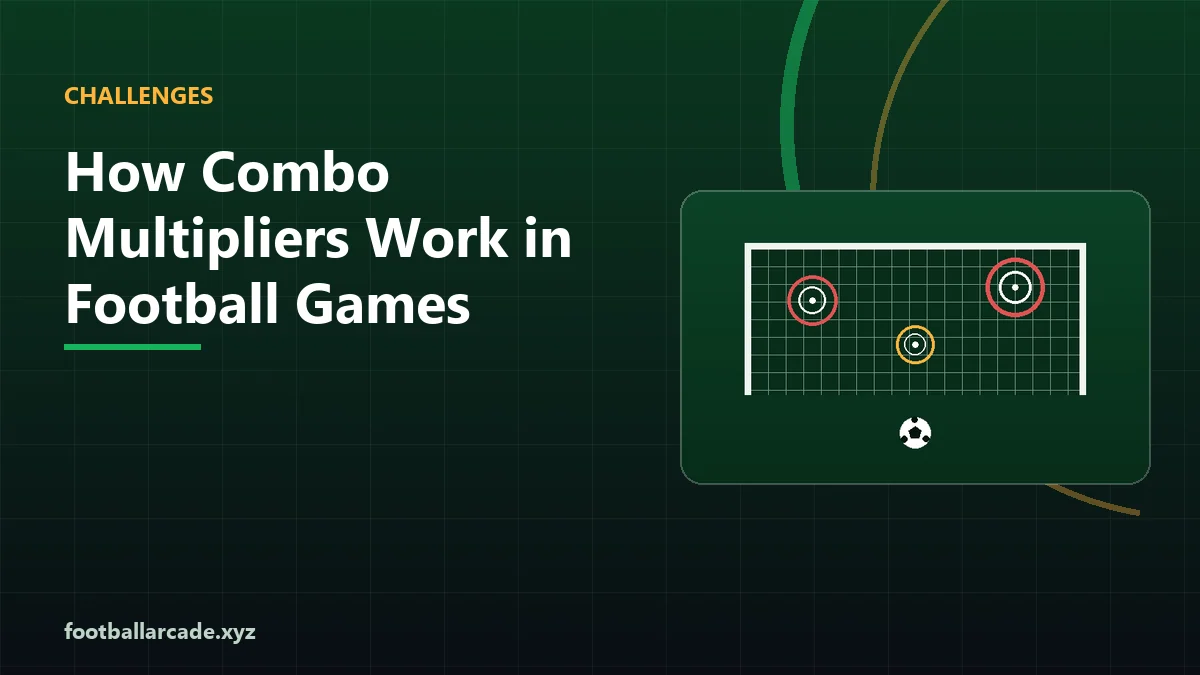
The test to apply: if losing this multiplier would cost more than the extra value of the risky option, take the safe option. Almost always it would. How Combo Multipliers Work has the arithmetic.
Penalties tell you the game's real subject
What a game punishes reveals what it is about more clearly than what it rewards.
- Reset multiplier — the game is about consistency.
- Lost life — the game is about survival, and points are a by-product.
- Time penalty — the game is about accuracy under pressure, and guessing is being discouraged.
- Wasted attempt — the game is about deliberation, and volume is not the answer.
Our reaction test adds 250 milliseconds for a wrong direction and 400 for a false start specifically to close the guessing exploit. That penalty structure is the design.
Reading a new game's system in one round
Four questions, answerable in a couple of minutes:
- What is the largest single number? That is the dominant term and your first priority.
- Is there a multiplier? If so, what is the increment and the cap? Those give you the rebuild cost of a reset.
- What does a mistake cost? A reset, a life, a penalty or an attempt.
- Does any bonus have an obvious saturation point? If so, aim just inside it.
Every game on this site publishes its scoring table on the game page, so you can answer all four without playing at all.
What a bad scoring system looks like
Worth recognising, because it tells you whether a game is worth your time:
- Undisclosed. If you cannot work out how points are awarded after a round, you cannot optimise and the game is a slot machine.
- Uncapped multipliers. Makes early mistakes permanently run-ending and turns the game into a lottery about when your first error happens.
- Bonuses larger than base values. Encourages abandoning the objective, which usually means the designer has not played their own game enough.
- Rewards for volume alone. Produces spam rather than decisions. A reload or a shot clock is the standard fix, and its absence is a warning sign.
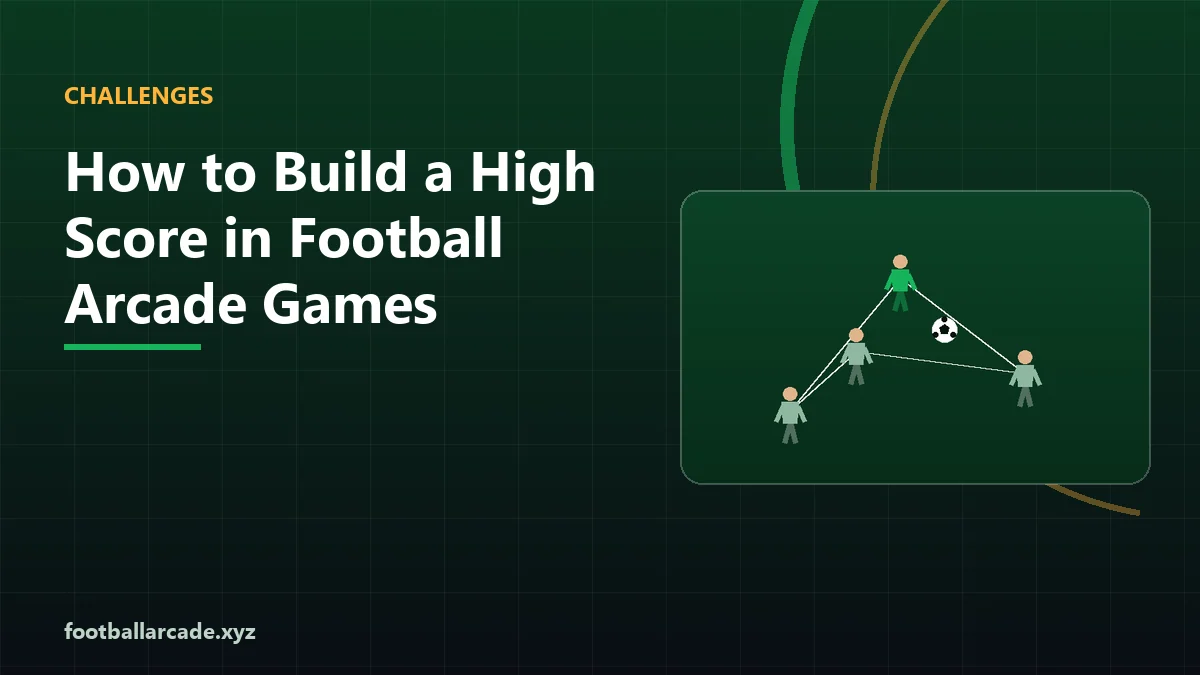
How to Build a High Score turns all of this into a method.
Reverse-engineering a system in one round
If a game does not publish its scoring, you can usually recover it in a single round by watching the score change rather than the game.
- Note the score after the first success. That is the base value, or base plus a bonus.
- Deliberately succeed poorly — a shot barely inside the frame, a barely-legal contact. The difference from the first figure tells you the size of the quality bonus.
- Succeed twice in a row and compare the second gain to the first. A larger second gain means a multiplier or a chain bonus.
- Fail once, then succeed. If the gain drops back to the base, the multiplier resets fully. If it drops partly, the chain decays rather than resetting — which changes strategy considerably.
Four deliberate actions and you know the system. That is a much faster route than inferring it from a dozen normal rounds, where several effects overlap and none is isolated.
Why we publish the formulas
A brief argument, since most games do not.
A hidden scoring system produces two bad outcomes. Players who cannot work it out play worse than they could and blame themselves or the game. Players who do work it out have effectively been made to do homework to access the design.
Publishing the rules costs nothing — the game is not competitive, there is no leaderboard to protect — and it converts the game from something you develop a feel for into something you can reason about. It also makes the guides on this site checkable, which is the point of our fact-checking policy: every figure we quote can be verified against the game's own source in your browser.