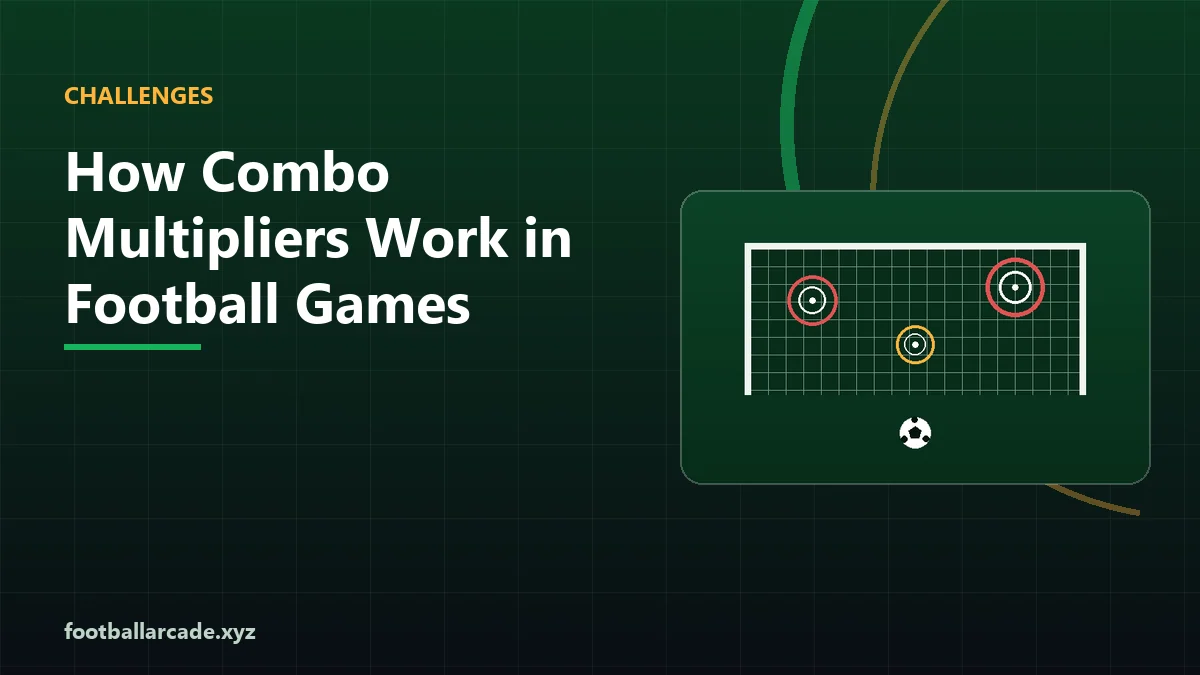
A combo multiplier looks like a bonus and behaves like an interest rate. Understanding the difference is worth more than any amount of extra accuracy, because it changes which shot you should take.
The two designs you will meet
Linear and capped
Each success adds a fixed increment up to a ceiling. Goal Target Challenge adds 0.2 per hit up to 3.0; Football Score Attack adds 0.15 per goal up to 2.5.
Capping is a player-friendly choice: it means a run remains recoverable after a mistake, because the ceiling is reachable again.
Additive chain bonus
Instead of multiplying, each success in a chain adds a growing flat bonus. One-Touch Football pays 10 plus 2 per pass in the chain, capped at 40.
Gentler than a multiplier and better suited to games where difficulty also rises with the chain, since the reward scales with the risk you are being asked to take.
Why one miss costs more than it looks
Because you do not lose the multiplier for one shot — you lose it for every shot until you rebuild it.
In Goal Target Challenge, going from 3.0x back to 1.0x means the next ten hits are needed just to return to where you were. If forty seconds remain, that is most of the rest of the round spent at a reduced rate.
| What you lose | Value |
|---|---|
| The ring you missed | 30–78 points |
| The multiplier difference on the next 10 hits | Several hundred points |
| The time spent rebuilding | About 10 shots, roughly 4 seconds of reload alone |
Which means the correct question before any shot is not "how much is this worth?" but "what is the chance this costs me the chain?"
The dominance rule
Where a multiplier and a scaled value bonus both exist, the multiplier almost always wins, because it compounds and the bonus does not.
A worked comparison from Goal Target Challenge:
- Option A: a fresh ring near your crosshair. Worth 30, at 3.0x that is 90, and you are confident.
- Option B: a nearly-expired ring across the goal. Worth 78, at 3.0x that is 234, but you are perhaps 60% confident.
Option B looks better and is not, once you include the chain: a 40% chance of dropping to 1.0x costs far more in expected value than the 144-point difference gains. And option A keeps you at 3.0x for option B's replacement a second later.
When to gamble
Three situations where taking the risky option is correct:
- Your multiplier is already 1.0x. There is nothing to protect, so take the highest value available.
- The round is about to end. With five seconds left, the chain has no future value. Spend it.
- The cap is unreachable. If you cannot reach the ceiling in the remaining time, the marginal value of extra chain length is lower than usual.
Outside those, protect the chain.
Multipliers in survival games
Endless games often have an implicit multiplier in the form of accumulated progress. In Football Dribble Run there is no multiplier, but distance already run functions like one: every second survived makes the next mistake more expensive, because you lose a longer run.
The behavioural implication is identical — risk appetite should fall as the run continues — which is why Survival and Endless Football Challenges gives the same advice from a different direction.
How to tell what a game's multiplier is worth
Two numbers tell you everything: the increment and the cap. From those you get the number of successes needed to reach the ceiling, which is the real cost of a reset.
- 0.2 per hit to 3.0 = ten hits to rebuild. Expensive.
- 0.15 per goal to 2.5 = ten goals to rebuild. Expensive.
- A small increment with no cap = catastrophic to lose, and usually a sign of a badly balanced game.
How Football Arcade Scoring Systems Work covers the other components, and Football High-Score Strategies applies this game by game.
Working out the break-even risk
You can make the "should I take this shot?" question arithmetic rather than intuitive, and the answer is usually more conservative than it feels.
Take Goal Target Challenge at 3.0x with thirty seconds left. A safe ring is worth 30 × 3.0 = 90. A risky ring is worth 78 × 3.0 = 234, so the upside is 144 points.
The downside of missing is the multiplier: dropping to 1.0x costs you roughly two-thirds of the value of every subsequent hit until you rebuild, and rebuilding takes ten hits. At a realistic three hits per two seconds, that is several hundred points of reduced value across the rest of the round.
So the risky shot needs to succeed something like four times out of five to break even. If you are not that confident, the safe ring is the better play — and most of the time you are not, which is why "protect the chain" is the default rather than a preference.
Why uncapped multipliers are a design mistake
Both multipliers on this site are capped, at 3.0 and 2.5. That is deliberate, and the reason is worth knowing because uncapped systems appear elsewhere.
With no cap, the value of a run becomes dominated by whenever your first mistake happens, since everything after it is played at a fraction of the potential. A run with an early error is effectively over, so the game becomes a lottery about the timing of your first slip rather than a test of sustained play.
A cap changes that completely: the ceiling is reachable again after a mistake, so a good run is recoverable and the skill being tested is consistency across a whole round rather than luck at the start of one.