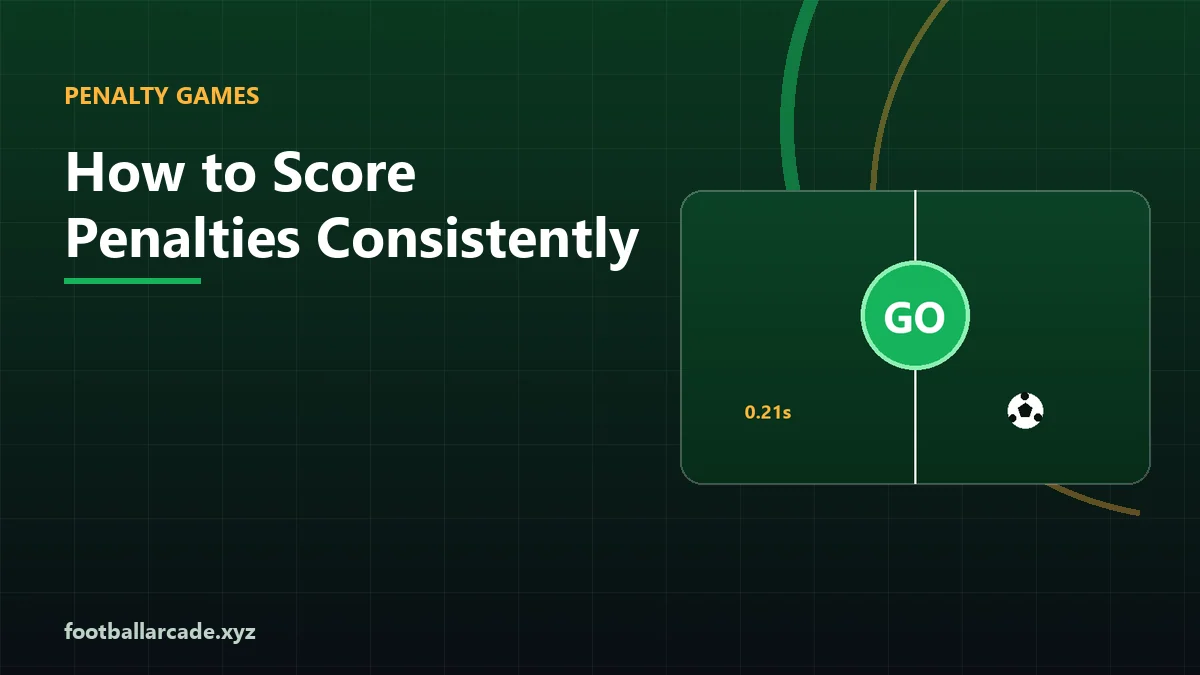

Here is the fact that explains nearly every timing-bar frustration: the marker does not stop where you saw it. It stops where it was when your press arrived, which is later — by your reaction time plus your hardware's latency, typically well over a tenth of a second.
At the speeds these games use, that is a real distance. In Penalty Kick Challenge the reticle crosses the goal in under a second on late kicks, so 150 milliseconds of delay is tens of pixels — always in the direction the marker was travelling.
The core technique: lead the target
Stop trying to press at the right moment and start pressing early on purpose. Decide where you want the ball, then press when the marker is a visible distance short of it.
How much? Start with roughly the width of the marker itself and adjust from what you observe. The exact figure is personal — it is your reaction plus your monitor plus your keyboard — which is why measuring it yourself beats any number an article can give you.
Play one round trying to hit the left post exactly — not inside it, on it. You will overshoot repeatedly. The distance you consistently overshoot by is your lead. Apply it everywhere.
Sweeping reticles: three things to know
- Sweep speed usually rises. Ours increases with each kick, so the lead you need grows through the round. Expect to lead noticeably more on kick nine than kick two.
- The marker is a sine wave, not a constant sweep. It slows near the edges and is fastest through the middle. That means a central target needs the biggest lead and a wide target needs the least — which is a hidden argument for aiming wide.
- The direction of travel matters. Your error is always downstream. If you want the left post and the marker is travelling left, you press earlier than you would if it were travelling right toward it.
Power meters: a different problem
A power meter oscillates rather than sweeping across a target, and it usually has a threshold rather than a bullseye. That changes the technique completely.
You are not trying to hit a value. You are trying to stay inside a band — 70% to 90% in our penalty game — and avoid a threshold at 94%. So:
- Press on the way up, not at the peak. Pressing near the top means your latency carries you over the threshold. Pressing during the rise means your latency carries you further into the band, which is harmless.
- Do not aim for maximum safe power. The difference between 85% and 90% is a point or two of bonus. The difference between 90% and 95% is the whole kick.
That asymmetry — a small gain on one side, a total loss on the other — is why the correct target is the middle of the band and not its upper edge.
How many bars, and in what order
| Game | Stages | Hardest stage |
|---|---|---|
| Penalty Kick Challenge | Placement, power | Placement, because the sweep accelerates each kick |
| Free Kick Master | Placement, power, curve | Curve, because it decides where the ball finishes |
| Crossbar Challenge | Angle, power | Power, because the target is 11 pixels tall |
| Football Score Attack | Placement only | Neither — the shot clock is the pressure |
Multi-stage sequences have a hidden cost: each press resets your rhythm. The gap between locking placement and the power meter starting is short, and players who are still thinking about their first press are late on the second. Decide both before the first one.
Practice that transfers
One-Touch Football is the best timing trainer on the site precisely because it strips away everything else. One input, no aiming, and a ring that tightens as the ball arrives — so the timing window is visible rather than inferred.
Two minutes there before a penalty round measurably improves the second bar, because you have spent two minutes doing nothing but calibrating when a press lands. A Warm-Up Routine Before High-Score Runs has the full sequence.
What will not help
Trying to react faster. Your reaction time is what it is on a given day, and the whole point of leading a target is that you stop needing to react at all — you are executing a decision you already made. Players who improve at timing games are not getting quicker; they are getting earlier.
Why your lead changes between games
Once you have measured your lead time, you will notice it does not transfer cleanly between games. That is not inconsistency on your part — the required lead depends on how fast the marker is moving, and that differs by game and by moment.
| Game and stage | Marker behaviour | Lead needed |
|---|---|---|
| Penalty Kick Challenge aim, kick 1 | Slowest sweep of the round | Small |
| Penalty Kick Challenge aim, kick 10 | Roughly twice as fast | Roughly double |
| Power meters | Oscillating, and you want a band not a point | Press during the rise; exact lead barely matters |
| Crossbar Challenge angle | Slow by design | Minimal |
| Football Score Attack reticle | Constant through the run | Constant — the easiest to learn |
The practical consequence is that Score Attack is the best game on the site for learning lead time, because its sweep speed never changes. Get your timing calibrated there and the penalty game becomes a matter of scaling the same instinct up as the round progresses.
The one situation where you should not lead
Contact-band games. In Soccer Juggle you are not stopping a marker at a point — you are pressing while an object is inside a region. Leading there means striking early in the band, which is the low-quality contact that starts the spiral described in Football Juggling Tips.
The distinction is worth holding onto: lead a moving marker, wait for a moving object. Almost every timing mistake in this genre is one of those two rules applied to the wrong kind of game.