
"Reaction game" covers three quite different things, and choosing between them depends on whether you want a measurement or an improvement. They are not the same goal.
1. Football Reaction Test — the measurement
Football Reaction Test is eight rounds of directional response. A random hold of 1.2 to 2.8 seconds, then the ball breaks left or right, and you press the matching arrow. Wrong direction adds 250 milliseconds; a false start adds 400 and the round is retaken. Your result is the average.
What it measures: the whole chain from screen to key press, including a decision. It is a choice reaction test rather than a simple one, which makes it slower and more relevant to football, where you almost never simply react.
Worth it for: a baseline you can compare against yourself. Not for training — eight rounds is too few repetitions to build anything.
2. Goalkeeper Reflex — the training
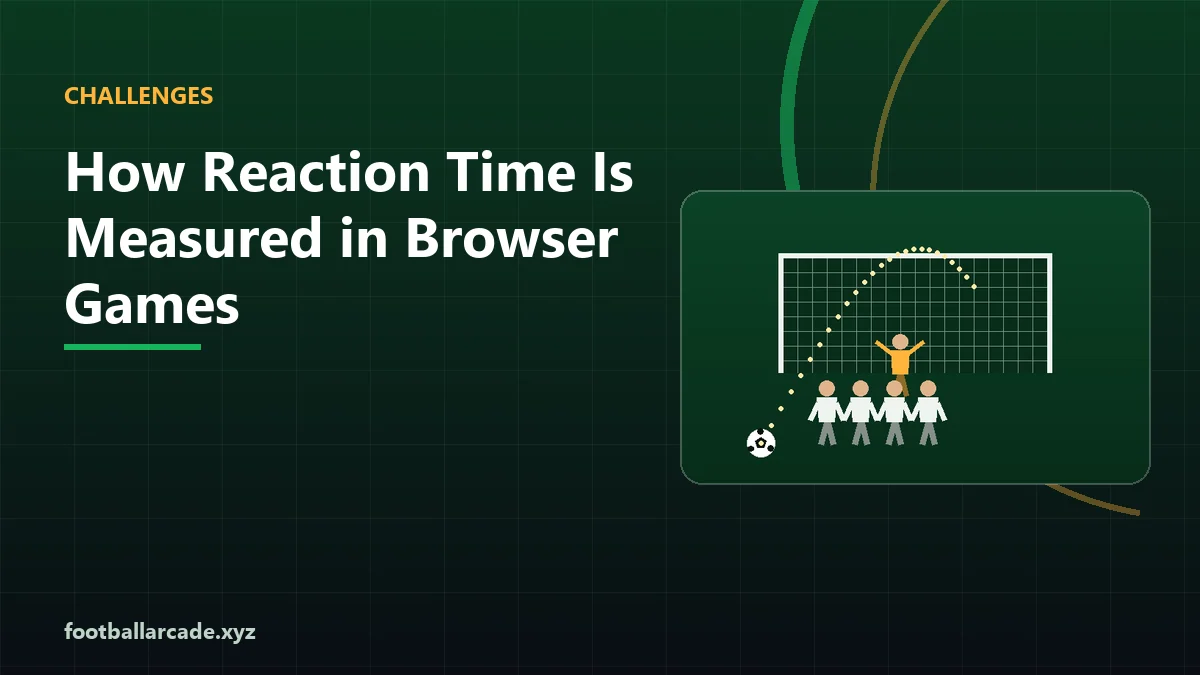
Goalkeeper Reflex puts a cost on committing early and gives you partial information instead of a clean cue.
What it measures: reaction under the conditions that make reaction difficult. The pre-shot cue is deliberately offset by up to 110 pixels, so it tells you the side but not the corner. A dive extends your reach but locks you out for 0.55 seconds. And you have to manage position at the same time.
Worth it for: actually improving. Partial information, a cost for guessing, and a competing demand on your attention is what reactions look like in practice — and the escalation (wind-up shortening from 0.55s to 0.28s, flight from 0.80s to 0.38s) gives you a ramp to work against.
3. One-Touch Football — the calibration
One-Touch Football is not usually thought of as a reaction game, and in a strict sense it is not: the arrival is predictable. That is exactly why it is useful.
What it measures: your ability to press at an intended moment rather than a reactive one, with the timing window drawn on screen as a tightening ring.
Worth it for: warming up before either of the others, and for learning the difference between anticipating and reacting — which is the distinction that improves a reaction score more than speed does.
Which to play for which purpose
| You want | Play | Why |
|---|---|---|
| A number to compare | Football Reaction Test | Averaged over eight rounds, so consistency counts |
| To get better | Goalkeeper Reflex | Partial information and a real cost for guessing |
| To warm up | One-Touch Football | Isolates intentional pressing |
| Sustained attention | Football Dribble Run | Continuous decisions for minutes rather than seconds |
The habit that improves all of them
Hand position. In every one of these games, a meaningful share of your measured time is your fingers travelling to the key rather than your nervous system responding.
Rest your fingers on both arrow keys before the round starts. On touch, keep your thumb near the centre line so both sides are equally close. This is worth more than any amount of practice and takes no practice at all.
The habit that ruins all of them
Anticipation. In the reaction test a wrong direction costs 250 milliseconds and a false start 400, which means guessing loses at any realistic hit rate. In the keeper game an early dive locks you out for 0.55 seconds.
Both games are built specifically to punish it, because anticipation is the thing that feels like skill and is not. How to Improve Reaction Time in Football Games has the full breakdown, and How Reaction Time Is Measured explains what the number contains.
What each game measures, precisely
"Reaction" covers several different measurements, and the three games here sit at different points on that scale. Knowing which is which stops you comparing numbers that are not comparable.
| Game | Measures | Includes a decision? | Includes positioning? |
|---|---|---|---|
| Football Reaction Test | Time from cue to a correct directional key | Yes, two-choice | No |
| Goalkeeper Reflex | Whether you were in the right place at the right time | Yes, with a cost for guessing | Yes |
| One-Touch Football | Accuracy of an anticipated press | No | No |
The third row is the one people misfile. One-Touch Football is not a reaction game at all — the arrival is predictable, so a good player is anticipating rather than reacting. That is exactly why it is the best warm-up: it trains the intentional press, which is what every other timing game on the site actually rewards.
A ladder, easiest to hardest
- One-Touch Football. Predictable timing, one input, visible window.
- Football Reaction Test. Unpredictable timing, two inputs, no positioning.
- Goalkeeper Reflex. Unpredictable timing, partial information, positioning, and a cooldown on your only strong action.
- Football Dribble Run at the speed cap. Continuous decisions for minutes at a time — sustained attention rather than single reactions.
Each rung adds exactly one demand. If a rung feels impossible, the one below it is usually not yet automatic.