
The usual framing is that simulation games are realistic and arcade games are not, with the implication that one is serious and the other is a toy. That framing is wrong in a way that makes it hard to choose between them.
The real difference is about abstraction. A simulation tries to model the whole system — 22 players, a full match, fatigue, tactics — and accepts complexity as the price. An arcade game isolates one moment and models it deeply enough to be interesting, accepting a narrow scope as the price. Both are design decisions, and both produce games that can be shallow or excellent.
The five real differences
| Arcade | Simulation | |
|---|---|---|
| Scope | One moment, modelled in detail | A whole match or season, modelled broadly |
| Inputs | One to three, learnable in seconds | Many, with combinations and context sensitivity |
| Session | 30 seconds to 5 minutes | 15 minutes to many hours |
| Learning curve | Understand immediately, master slowly | Understand slowly, master very slowly |
| Failure cost | Seconds — restart and go again | Minutes to hours of progress |
The last row is the one that matters most day to day. Cheap failure is what makes an arcade game something you can improve at quickly: you get dozens of attempts at the difficult part in the time a simulation gives you one.
Where arcade games are genuinely deeper
This sounds contrarian and is straightforwardly true in one respect: because an arcade game models one moment, it can model it in more detail than a simulation can afford to.
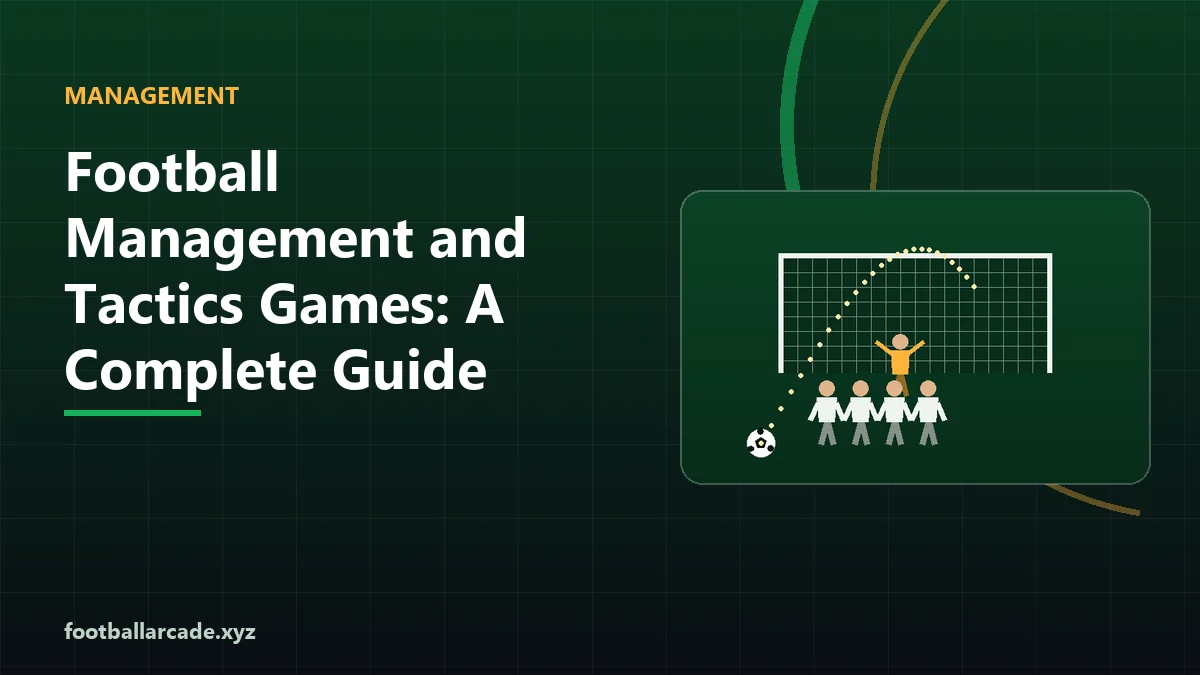
Take a penalty. In most full football simulations a penalty is a short interaction — aim, power, a keeper roll — because the game has a whole match to run. In Penalty Kick Challenge, which does nothing else, the same moment has a power-to-height mapping with a stated threshold, a keeper with a reading probability that escalates over ten kicks, a dive that takes 0.55 seconds to complete and is interpolated against the ball's flight time, and a save test based on distance from the keeper's hands.
That is a more detailed model of a penalty than most simulations contain. It is just a model of nothing else.
Where simulations are irreplaceable
Everything that emerges from interaction between parts. A simulation can produce a situation nobody designed — a full-back caught upfield because of a substitution twenty minutes earlier, a match that changes shape because of fatigue. Arcade games cannot generate that, because they have no parts to interact.
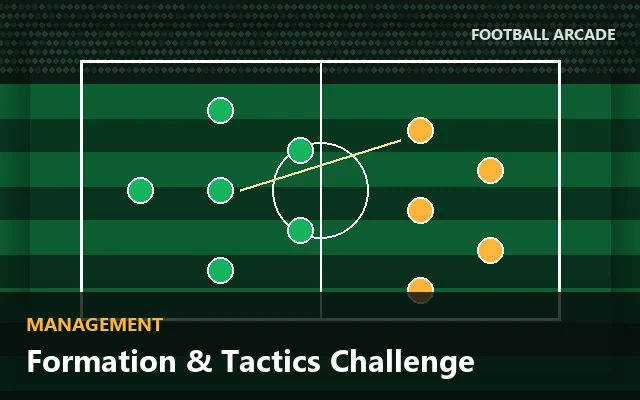
Management games sit interestingly in between. Formation & Tactics Challenge is arcade in structure — six fixtures, a few minutes, one decision each — but simulation-like in content, because what it models is a matchup rather than an action. Football Management and Tactics Games explores that.
Controls: the clearest practical difference
An arcade game's control scheme has to be learnable without instructions, which constrains it to about three inputs. That constraint is productive: it forces the design to put the difficulty in when you press rather than what you press.
A simulation's control scheme assumes investment. Multiple sticks, modifiers, context-sensitive actions — which allows expression an arcade game cannot offer, at the cost of a period where you are fighting the controller rather than the game.
This is why arcade games work on a touchscreen and full simulations largely do not: Football Arcade Game Controls Explained goes into what each input is good at.
Which should you play?
Match the game to the constraint you actually have.
- You have under five minutes. Arcade, every time. A simulation cannot deliver a complete experience in that window, and an interrupted one is worse than none.
- You want to improve at something measurable. Arcade. Cheap, fast failure plus a clear score is the ideal structure for deliberate practice.
- You want a story or a season. Simulation. Arcade games have no narrative machinery and are not pretending to.
- You are on a phone, one-handed, possibly about to be interrupted. Arcade, and specifically a game with no clock — our tactics game is built for exactly that.
- You want to feel like you are playing football. Simulation, honestly. Arcade games feel like playing a game about football, and the good ones are not trying to hide it.
A note on "realism"
Realism is a strange criterion for a football game, because both approaches are unrealistic in different directions. A simulation gives you godlike control over 11 players and a camera above the pitch. An arcade game gives you a power meter. Neither resembles what a footballer experiences.
What both can be is faithful — true to the structure of a football decision even while abstracting its execution. A free-kick game where you must aim past a wall and bend the ball back is faithful in that sense, even though a sweeping meter is nothing like striking a ball. How Curve and Swerve Work in Football Games shows how that approximation is built.
The hybrid that works best
If you play simulations regularly, arcade games are unusually good as a complement rather than a substitute:
- They isolate skills your simulation glosses over. Five minutes of Goal Target Challenge is more shooting decisions than a full simulated match.
- They fit the gaps. The ten minutes where starting a match is pointless.
- They give you a number. Simulations rarely tell you whether you are improving; an arcade personal best does nothing else.
How the split happened
The divide is older than video games having a football genre at all, and it comes from hardware rather than taste.
Coin-operated cabinets had a hard constraint: a game had to be legible to a stranger within seconds and had to end, because the business model depended on it. That produced immediate starts, visible objectives, escalating difficulty and a score — the design language we still call "arcade". Home machines had the opposite constraint: you already owned the game, so it needed to be worth returning to for weeks. That rewarded depth, simulation and long-form progression.
Browser games inherited the arcade constraint for a new reason. A web page has seconds to convince you to stay, and nobody has invested anything in loading it. The economics changed; the design pressure did not.
The middle ground nobody talks about
Two hybrids are worth knowing, because they are where most interesting football game design currently happens.
Set-piece mini-games inside simulations
Most full football games contain arcade games: a penalty shootout, a free kick, a skill drill. They are usually shallower than a dedicated arcade game because the parent game has a whole match to run — which is exactly why a standalone penalty game can out-model a simulation's penalty.
Arcade-structured management games
Formation & Tactics Challenge is arcade in shape — six fixtures, five minutes, one decision each — and simulation-like in content, because what it models is a tactical matchup rather than an action. There is no timing element at all, but there is also no squad, no finances and no season-long progression.
This is the most underrated category in browser gaming: all of the reasoning of a management game, none of the twenty-hour commitment.
Telling them apart in thirty seconds
Useful when you land on an unfamiliar game and want to know what you are in for:
| Question | Arcade | Simulation |
|---|---|---|
| How long before you are playing? | One click | A menu, a team selection, a loading screen |
| What does failing cost? | Seconds | Minutes of progress |
| Can you explain the objective in one sentence? | Yes | Not really — there are several |
Which one actually makes you better at football games
Arcade, and by a wide margin, for a structural reason rather than a philosophical one: repetition.
A simulation gives you perhaps a handful of shooting decisions in a full match, spread across twenty minutes. Five minutes of Goal Target Challenge gives you around a hundred, each with immediate feedback and a score you can compare. If you want to improve at a specific skill, the arcade game is not a lesser version of the simulation — it is the practice tool the simulation cannot be.
The reverse is also true. If you want to understand how a match develops, no amount of penalty practice will teach you, because arcade games have no interacting parts to produce a match.
A fair criticism of each
Worth stating, because "both are good" is not an argument.
- Arcade games abstract away the hard part of football. Placing a shot with a power meter is not striking a ball. The decision is faithful; the execution is a symbol of execution.
- Simulations abstract away the hard part of playing. You control eleven players from above with perfect information, which is nothing like what a footballer experiences. Neither is "realistic"; they are unrealistic in opposite directions.
A Complete Guide to Football Arcade Games covers what the arcade side does model in detail, and does not overclaim what it cannot.
The one thing both get right
For all their differences, arcade and simulation football share a design instinct that most other sports games lack: both treat football as a series of decisions under constraint rather than a test of dexterity. A simulation constrains you with twenty-one other players; an arcade game constrains you with a meter and a clock. In both cases the interesting question is the same — what is the best available option right now, and what does getting it wrong cost?
That is why players who enjoy one usually enjoy the other once they stop expecting it to be a version of the first.